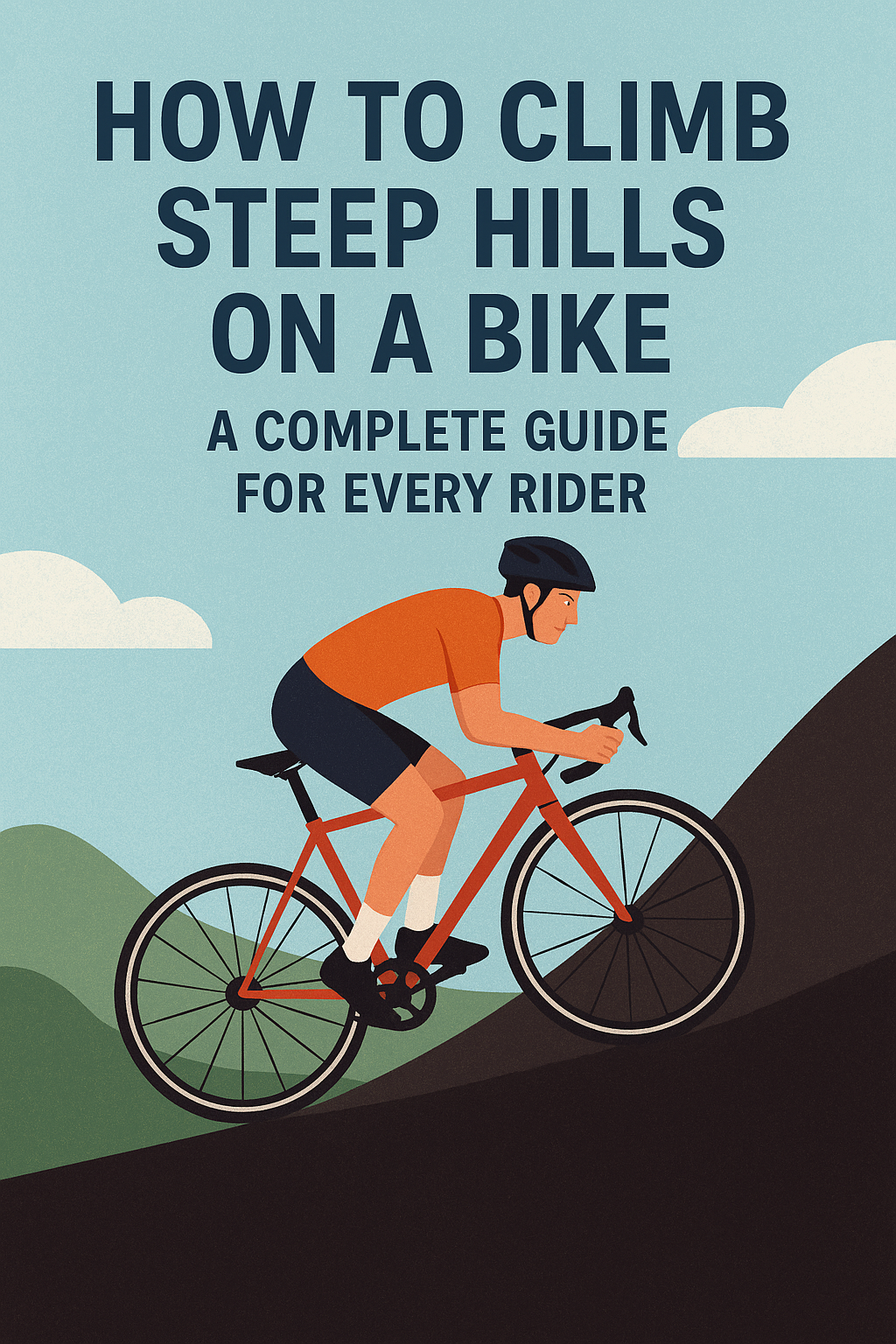
We’ve all been there – rolling along comfortably, when suddenly the road tilts upward and you’re staring at what looks like a wall of asphalt. Your legs feel heavier, your breathing quickens, and a tiny voice in your head says, “There’s no way I can get up that.”
But here’s the truth: climbing steep hills on a bike doesn’t have to feel like pushing a piano upstairs. With the right mindset, technique, and preparation, hills can transform from dreaded obstacles into powerful training partners. They make you stronger, fitter, and mentally tougher. And let’s be honest—there’s no better feeling than reaching the top, looking back, and realizing, “I just conquered that.”
Let’s break it down step by step.
1. Mind Over Mountain – Winning the Mental Battle
Before your legs even start turning, the first challenge happens in your head. Many cyclists psych themselves out before they reach the base of the hill. Instead of seeing it as punishment, try reframing the climb as an opportunity.
Think of every hill as a video game “boss level.” It’s tough, yes, but not unbeatable. Approach it as a series of mini-goals rather than one overwhelming wall. Focus on reaching the next tree, lamppost, or curve. Then reset and aim for the next marker. Suddenly, the impossible becomes manageable.
Pro Tip: Smile at the hill as you approach it. This might sound silly, but smiling relaxes your face and body, reducing tension. It shifts your brain from fear to acceptance.
2. Gearing – Your Secret Weapon
Nothing determines your hill-climbing comfort like your gear setup. Modern road bikes often come with a compact crankset (34-tooth chainring) and a cassette that can go up to 32–34 teeth. Mountain bikes and hybrids usually offer even easier gears.
Here’s the golden rule: It’s better to have gears you don’t need than to need gears you don’t have.
Using an easier gear allows you to “spin” at a high cadence instead of “grinding” at a slow, painful pace. Spinning (around 80–100 revolutions per minute) reduces stress on your knees and keeps your muscles fresher. Grinding, on the other hand, feels powerful at first but burns your legs out quickly.
Real-world example: Imagine riding a 12% climb in a hard gear. You’ll crawl up at 40 RPM, each pedal stroke feeling like lifting weights. Switch to an easier gear and suddenly you’re turning your legs faster, maintaining momentum, and breathing rhythmically. Same climb, less suffering.
3. Shift Before You Suffer
A common rookie mistake is waiting too long to downshift. If you try to change gears while mashing your pedals under high pressure, your derailleur and chain will protest loudly—and sometimes fail to shift.
Instead, anticipate the gradient. As soon as you see the slope kick up, ease off slightly, shift to an easier gear, and keep pedalling smoothly. Think of it like changing gears in a car: you wouldn’t wait until the engine is screaming before shifting down.
If you’re a beginner, aim to keep your cadence around 85–95 RPM. This sweet spot keeps your legs moving efficiently and reduces fatigue.
4. Keep the Pedals Turning – Momentum Matters
Momentum is your ally. Entering a climb with speed gives you a “free boost” before gravity fully kicks in. But once you’re on the hill, consistency is everything. The moment you stop pedalling, restarting on a steep gradient feels like trying to launch a rocket.
Work on developing a smooth pedal stroke. Instead of just stomping down, think of pedalling in circles—pushing forward, down, pulling back, and lifting up. This distributes effort more evenly and helps with traction.
5. Traction Control – Staying Planted
On very steep or slippery climbs, wheel slip is a real problem. This usually happens when you stand up and put too much weight over the front wheel, causing the rear to lose grip.
Solutions:
-
Stay seated whenever possible. Your body weight over the saddle naturally presses down the rear wheel.
-
If you must stand, hover just above the saddle and keep your hips slightly back.
-
Drop your heels on the downstroke. This pushes your weight into the pedals and keeps the tire pressed against the road.
Remember: too much forward lean = front wheel lifting. Too much backward lean = rear wheel slipping. Balance is everything.
6. Build Strength Off the Bike
Climbing isn’t just about lungs and legs—it’s also about core stability. A strong core keeps you steady in the saddle, prevents swaying, and lets you transfer more power to the pedals.
Exercises that help:
-
Planks: Builds overall stability.
-
Squats & lunges: Strengthen quads, hamstrings, and glutes—the muscles that drive you uphill.
-
Russian twists or leg raises: Improve rotational strength and control.
You don’t need to bulk up like a bodybuilder. The goal is functional strength—muscles that support efficient, powerful pedalling.
7. Pacing – Don’t Blow Up Early
The number one mistake new climbers make? Attacking the hill like it’s a sprint. Halfway up, they’re gasping, legs screaming, and forced to stop.
Instead, think of climbs like a marathon, not a sprint. Start conservatively, find a rhythm, and save energy for the top. Hills often have “false summits”—where you think you’re done, but the road keeps going. If you’ve paced well, you’ll have energy left to crest smoothly.
Rule of thumb: If you reach the top and feel like you could have gone harder, you nailed the pacing.
8. Fuel Your Engine
Climbing demands energy. If you’re running on empty, even small hills feel like mountains.
-
For rides under an hour: a light snack beforehand is enough.
-
For rides over an hour: aim for 30–60 grams of carbs per hour. That’s a banana, an energy bar, or half a PB&J sandwich.
-
Drink regularly: dehydration makes hills harder by increasing fatigue and muscle cramping.
Snack early, snack often. Don’t wait until you’re exhausted. By then, it’s too late.
9. Know the Climb Before You Ride It
Preparation makes a massive difference. Use apps like Strava, Komoot, or RideWithGPS to check elevation profiles before your ride.
Knowing where the steepest section lies allows you to save energy beforehand. For example, if the first kilometre is brutal but it eases off later, you can mentally prepare to endure the early suffering.
10. When to Walk Away
Sometimes, the hill wins—and that’s okay. Walking up a steep climb is not defeat, it’s smart cycling. There’s no prize for collapsing halfway up. Walking preserves your energy, prevents injury, and lets you live to ride again tomorrow.
Better yet, walking gives you a chance to scout the climb. Next time, you’ll know exactly what to expect and can pace accordingly. Each attempt brings you closer to conquering it. When you finally crest that summit without stopping, the sense of achievement is unmatched.
Climbing steep hills isn’t about brute force—it’s about preparation, pacing, technique, and mindset. The more you practice, the better you’ll get. And every time you push past the voice that says “you can’t,” you’re not just building cycling strength—you’re building resilience for life.
So the next time you face a daunting climb, don’t dread it. Break it into steps, trust your gears, fuel your body, and keep turning those pedals. You’ll discover that hills aren’t barriers—they’re milestones of progress.


 ENG
ENG