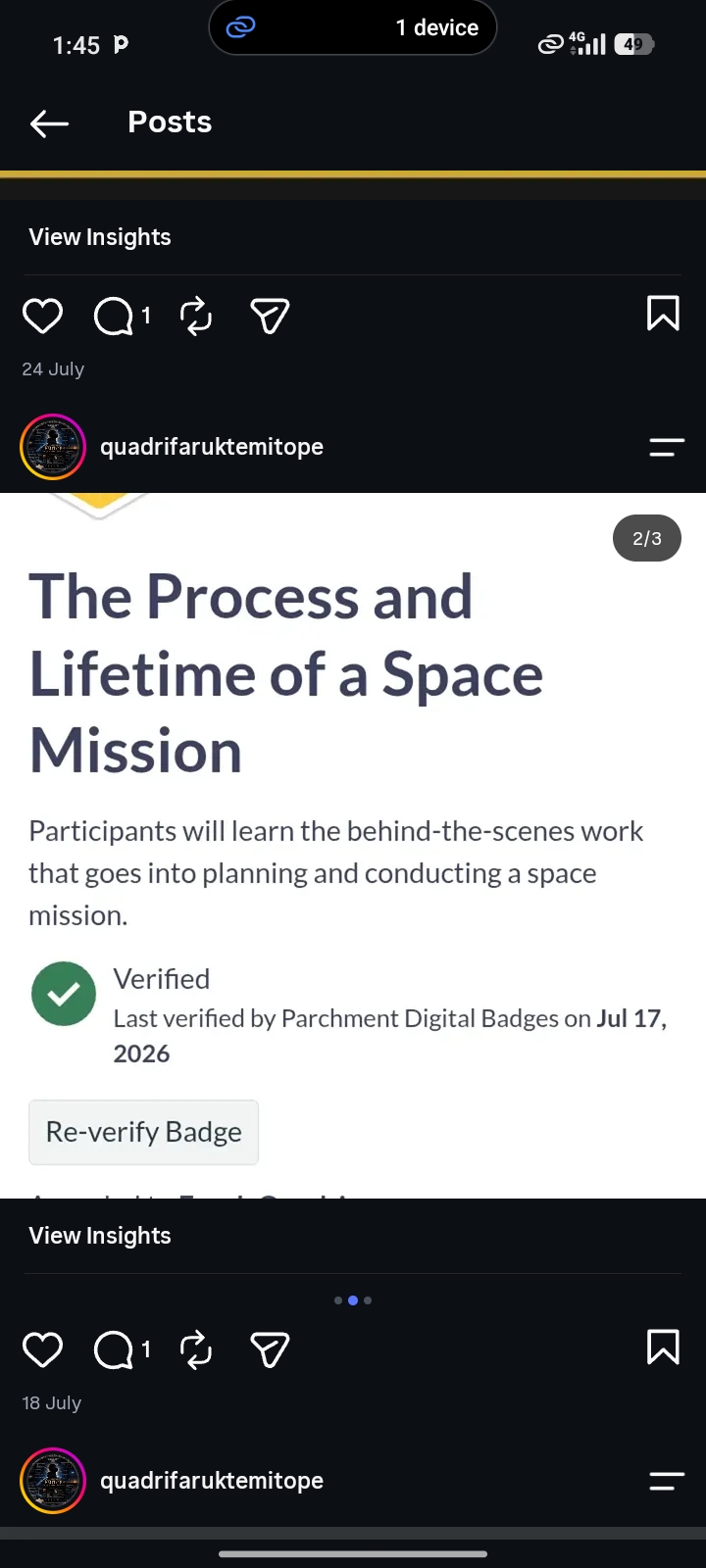
Space exploration has always fascinated me, particularly the science, engineering, and planning involved in sending spacecraft beyond Earth.
I explored The Process and Lifetime of a Space Mission, gaining insight into the different stages involved in designing, developing, launching, operating, and eventually retiring a space mission.
A space mission involves several interconnected stages, including:
Mission Planning: Defining the mission objectives, requirements, and scientific goals.
Design and Development: Designing spacecraft, instruments, and supporting systems.
Testing and Verification: Ensuring that spacecraft systems can withstand the demanding conditions of space.
Launch: Delivering the spacecraft into its intended orbit or trajectory.
Commissioning: Activating and verifying spacecraft systems after launch.
Mission Operations: Monitoring spacecraft performance, collecting data, and executing mission objectives.
End-of-Life Management: Safely decommissioning the spacecraft through disposal, controlled re-entry, or other appropriate procedures.
One particularly interesting aspect is that a space mission does not simply end after launch. Its lifetime depends on several factors, including spacecraft design, available power, fuel, environmental conditions, component reliability, and mission objectives.
As an Electrical and Electronics Engineering student with a growing interest in satellite systems, astronomy, and space technology, I find this field particularly exciting.
Understanding the lifecycle of space missions gives me a broader perspective on the engineering disciplines required to make space exploration possible.
I look forward to deepening my knowledge of spacecraft systems, satellite communications, orbital mechanics, and space mission design.