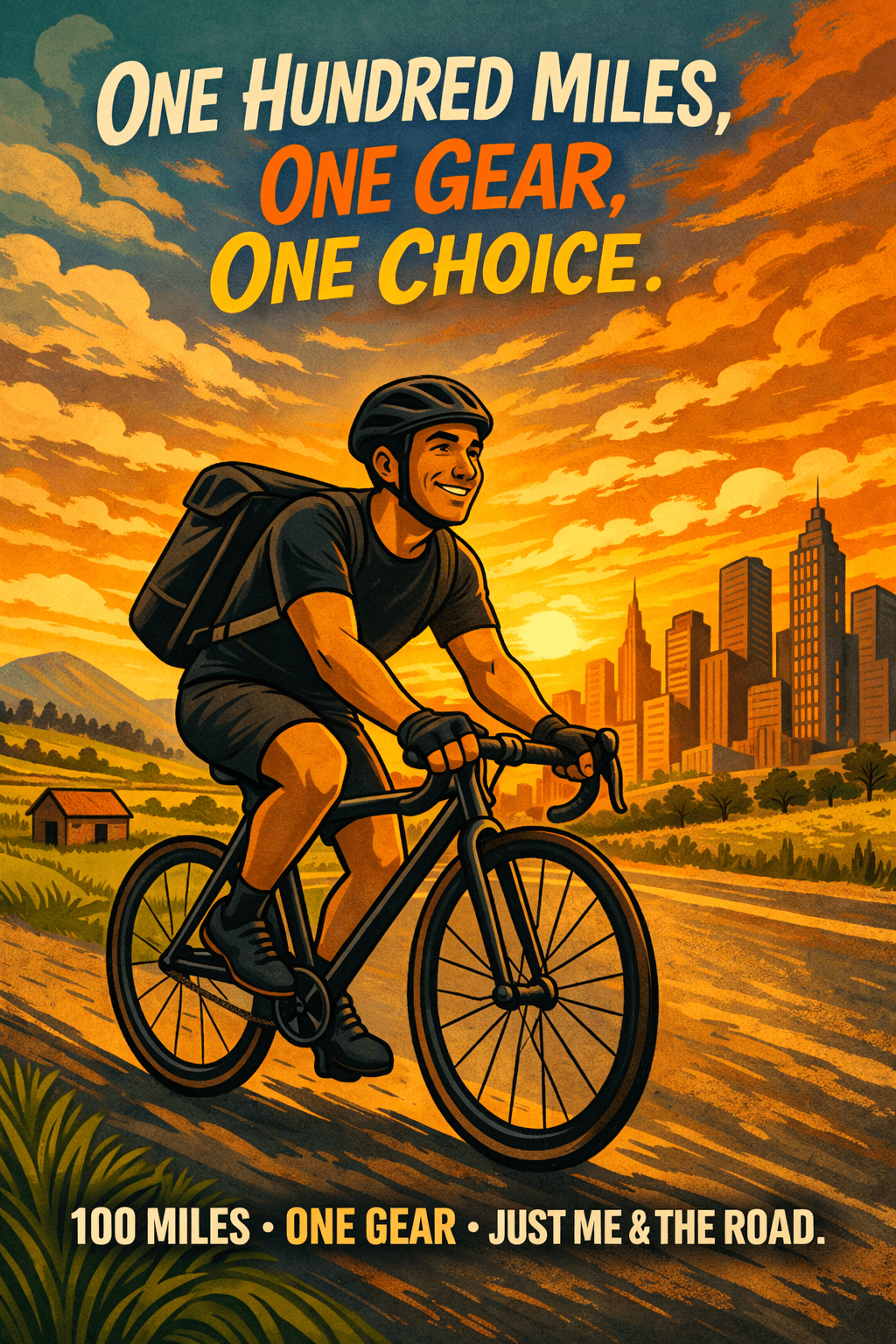
I’m not training for an Ironman ( is a 112-mile or 180.29 km ride).
There’s no finish arch waiting for me at sunrise, no timing chip strapped to my ankle, no announcer mispronouncing my name as I cross a line surrounded by noise. No crowd. No medals. No official validation that what I’m doing matters.
What I have instead is a single speed–fixed gear road bike, an open road that doesn’t care who I am, and a challenge I chose for one simple reason: to see what I’m capable of when there’s nothing left to rely on but myself.
I’ve never been drawn to extreme endurance events because of recognition. I respect those who chase them, but that hunger was never mine. What always pulled me in was something quieter—the discipline of showing up when no one is watching, the honesty of effort that can’t be outsourced, and the strange clarity that comes from repetitive motion done with intention.
Riding a single speed or fixed gear bike strips cycling down to its bare bones. No gears to hide behind. No mechanical bargaining. No shortcuts. Just legs, lungs, balance, and resolve—applied again and again until the road decides you’ve earned passage.
Choosing Difficulty on Purpose
Most people train to make things easier.
They chase lighter bikes, smoother drivetrains, optimized setups, data-driven gains. And that makes sense. Efficiency is seductive. Progress is often marketed as reduction of effort.
I chose the opposite.
I chose a single speed not because it’s efficient, but because it’s demanding. Because it asks questions instead of providing answers. Every incline challenges your patience. Every headwind exposes weakness you can’t spin away. Every long stretch of flat road dares you to stay disciplined when boredom sets in.
Before this, I wasn’t chasing anything dramatic. No ultra-distance résumé. No competitive background. I hadn’t even labeled myself as an endurance rider. I simply felt that familiar restlessness—the subtle discomfort of realizing that comfort had begun to feel like stagnation.
So I created a challenge that couldn’t be solved with money, technology, or excuses.
If I was going to struggle, I wanted the struggle to be honest.
From Gears to Simplicity
There was a time when my rides were defined by equipment.
Mountain bikes for broken roads and trails, suspension absorbing mistakes and encouraging aggression. Road bikes for speed, cadence, and control—gears ready for every possible scenario. I believed progression meant upgrading: lighter frames, smoother components, more options at my fingertips.
And for a while, that belief was true. It matched who I was then.
But somewhere along the way, I started craving less.
Less noise.
Less complexity.
Less dependence on things outside myself.
The single speed wasn’t a downgrade—it was a deliberate narrowing of focus. One gear. One rhythm. One continuous conversation between effort and movement. No negotiation with the bike. Only negotiation with myself.
The bike didn’t change to suit me.
I had to change to suit the ride.
Training Without a Finish Line
My training doesn’t follow a race calendar.
There’s no tapering phase, no countdown app, no post-event celebration planned in advance. The goal isn’t peaking—it’s consistency. Showing up repeatedly, even when motivation is low and progress feels invisible.
Some days that means short, brutal rides focused on cadence and control. Learning to smooth out power delivery, to pedal circles instead of punches. Other days it’s long hours in the saddle, letting fatigue become a teacher instead of an enemy.
Hills are no longer obstacles; they are instructors.
On a single speed, you don’t attack climbs—you negotiate with them. You enter with humility, knowing there’s no lower gear waiting if you misjudge. Pace becomes instinctual. Effort becomes measured.
Rainy days don’t cancel training. They simply change the lesson. When riding outdoors isn’t possible, I use a stationary bike set to a single resistance, mimicking the unchanging demand of fixed gear riding. It’s monotonous. Repetitive. Unforgiving.
But so is life sometimes.
Learning to stay present through repetition is part of the work.
Hills, Humility, and Momentum
People often ask how I deal with hills on a single speed.
The truth is, you don’t “deal” with them—you endure them.
There’s no bailout gear when your legs start screaming. No moment of relief when cadence drops and torque takes over. Once you commit to a climb, you commit fully. Turning back isn’t an option your pride allows easily.
Technique matters, but mindset matters more.
I’ve learned to respect momentum—to treat descents not as recovery but as preparation. Speed becomes borrowed time you carry into the climb ahead. Riding upright, engaging the whole body, accepting that some sections will be slow and uncomfortable—this isn’t failure. It’s reality.
The hills don’t care about ego.
They only respond to persistence.
The Quiet Arrival of 100 Miles
The idea of riding 100 miles didn’t arrive with fireworks.
It crept in quietly during shorter rides—usually when my legs were tired and my mind was louder than the road. The thought appeared casually, almost playfully:
What if I just kept going?
Not for a race.
Not for recognition.
Just to see where my limits actually were.
On a geared bike, 100 miles is a logistical challenge—nutrition, pacing, efficiency. On a single speed, it becomes personal.
There’s no hiding fatigue behind a lower gear. No rescuing bad decisions with clever shifting. Every mile demands payment in effort, and the price increases the longer you stay out there.
That was exactly why I wanted it.
Preparing Without Shortcuts
Training for 100 miles on a single speed wasn’t about building speed. It was about building trust.
Trust in my legs to keep turning long after novelty faded.
Trust in my mind to stay calm when discomfort became familiar.
Trust that simplicity, repeated enough times, could carry me farther than complexity ever did.
I trained in fragments at first. Thirty miles. Forty. Fifty.
Each ride taught me something different—about hydration, about pacing, about the danger of early enthusiasm. I learned when to push, but more importantly, when not to.
Wind became resistance training. Flat roads became tests of patience. Hills became long conversations where silence was often the best response.
There was no dramatic suffering. Just long stretches of quiet, honest work.
The Long Ride
When the day came to commit to 100 miles, it didn’t feel heroic.
It felt serious.
The early miles passed easily. The bike hummed. My breathing settled. Familiar roads slipped behind me without ceremony. There was no rush—only rhythm.
Somewhere around the halfway mark, the real conversation began.
My legs started asking questions my mind didn’t want to answer. The road felt longer than it looked. Time stretched. Every mile marker seemed slightly dishonest.
But simplicity has a strange power.
With nothing to adjust, nothing to optimize, all that remained was forward motion. Pedal. Breathe. Repeat. When fatigue arrived, it was acknowledged—not dramatized. When doubt surfaced, it was allowed to pass without negotiation.
Mile by mile, the distance stopped being intimidating and started becoming inevitable.
Not an Ironman—Just a Better Version of Me
Crossing the 100-mile mark didn’t feel explosive.
It felt complete.
Like closing a sentence properly after a long paragraph. Like exhaling after holding breath without realizing it. There was no rush of victory—just a deep, steady sense of understanding.
I didn’t feel like I had conquered anything.
I felt like I had learned something.
That progress doesn’t always mean adding more.
That strength often grows when options are removed.
That simplicity, when chosen intentionally, can be demanding—but deeply rewarding.
I may never pin a race number to my jersey, and that’s fine. My finish line moves every day. Sometimes it’s the top of a hill. Sometimes it’s simply getting back on the bike when motivation is low.
This isn’t about becoming an Ironman.
It’s about becoming resilient.
Disciplined.
Honest.
I still respect mountain bikes. I still admire fast road machines. But for where I am now, I choose simple.
One gear.
One bike.
One honest effort at a time.
One hundred miles wasn’t about proving I could do it.
It was about proving I didn’t need anything extra to try.