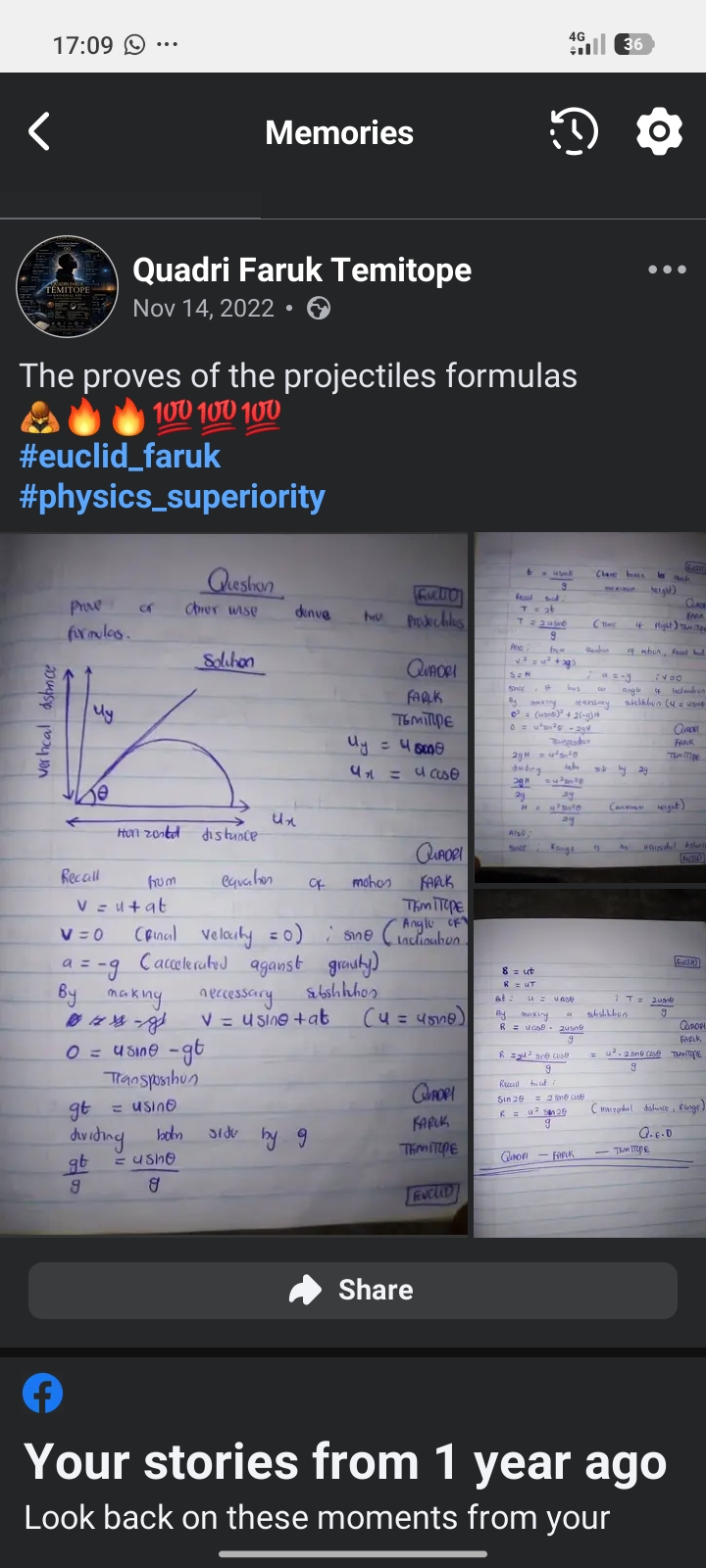
Projectile motion is one of the fascinating applications of classical mechanics, combining horizontal and vertical motion to explain the trajectory of an object moving under gravity.
In this contribution, originally shared on November 14, 2022, I presented a mathematical derivation of fundamental projectile motion equations using the principles of uniformly accelerated motion.
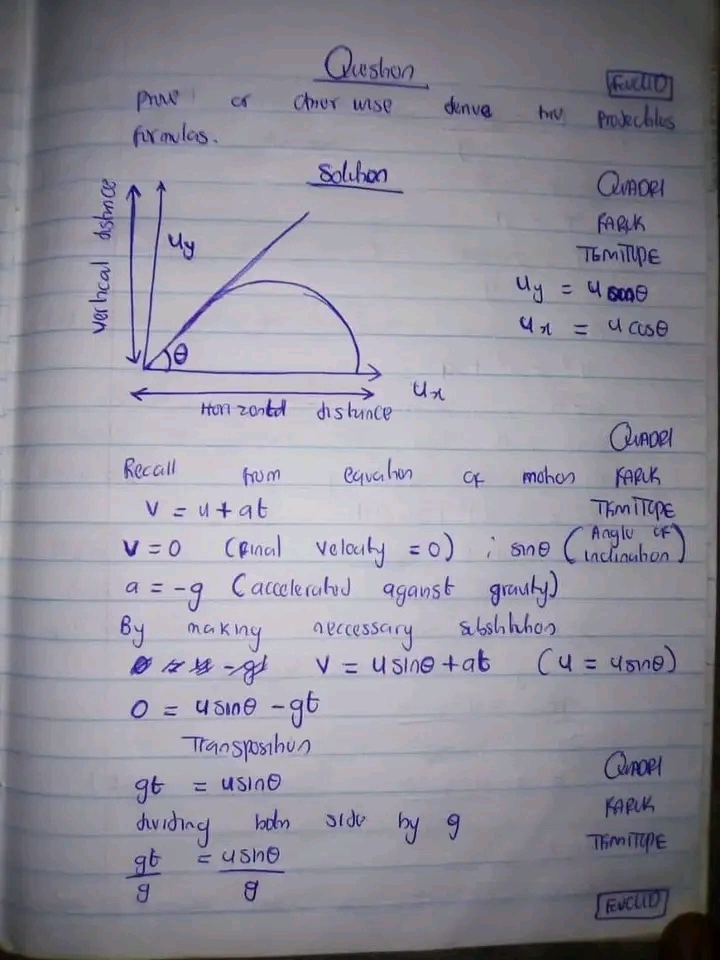
The derivation explored the resolution of initial velocity into horizontal and vertical components:
[
u_x=ucostheta
]
[
u_y=usintheta
]
Using these components and the acceleration due to gravity, I worked through the mathematical relationships governing projectile motion.
The fundamental results explored include:
1. Time of flight
[
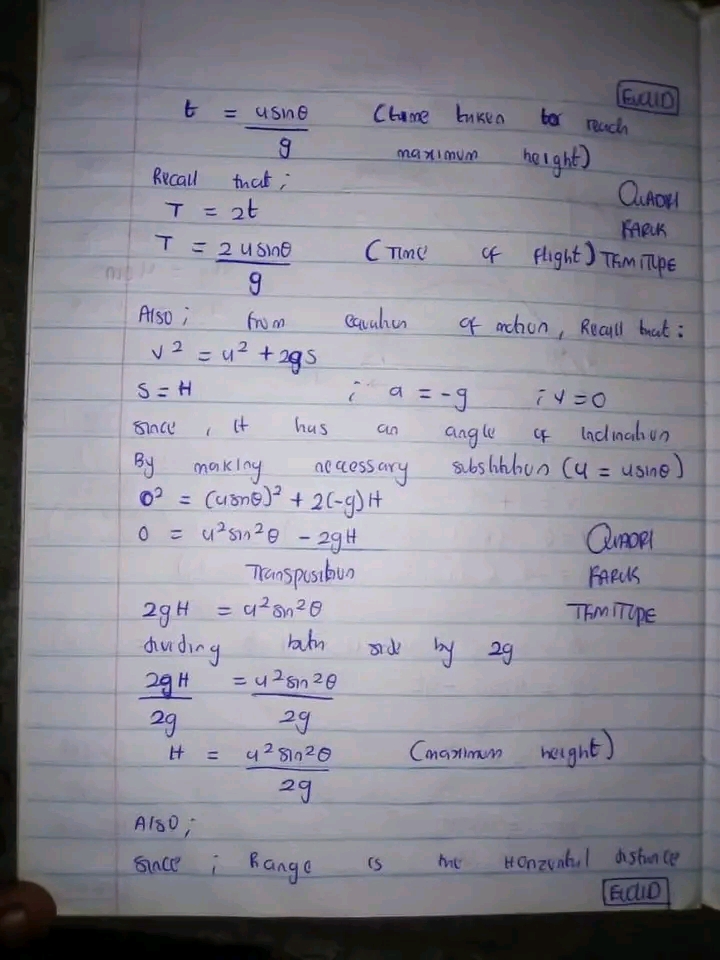
T=frac{2usintheta}{g}
]
2. Maximum height
[
H=frac{u^2sin^2theta}{2g}
]
3. Horizontal range
[
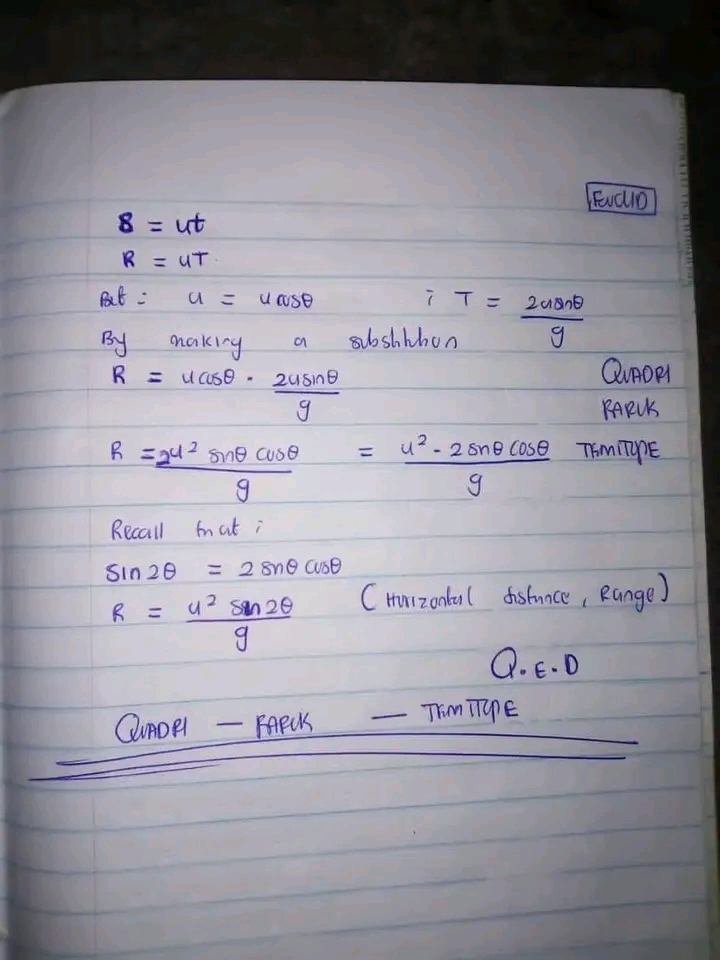
R=frac{u^2sin 2theta}{g}
]
This exercise demonstrates how the equations of projectile motion can be established through mathematical reasoning, velocity resolution and the application of the equations of uniformly accelerated motion.
It reflects my interest in theoretical physics, mathematical modelling and understanding the principles governing physical phenomena.
My philosophy: Every physics equation tells a story. Understanding its derivation allows us to appreciate the mathematics behind the physical world