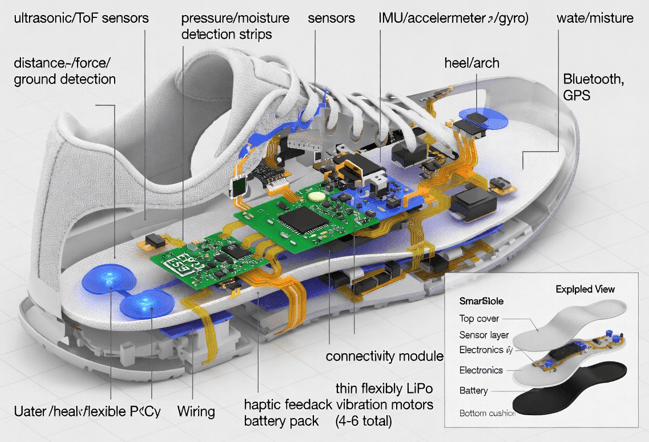
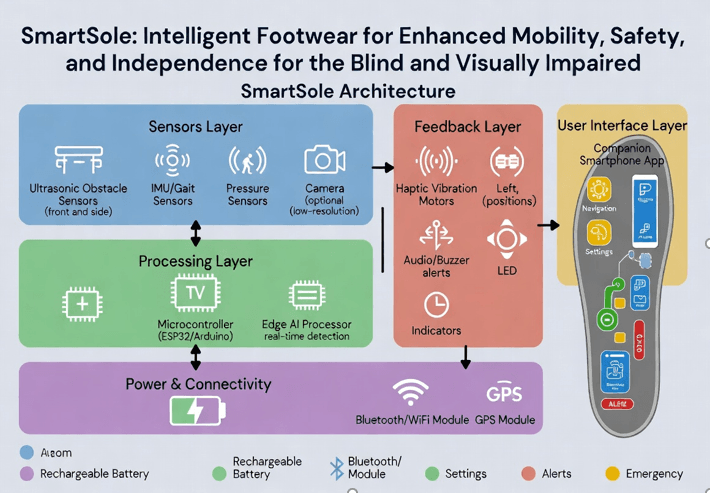
Millions of people who are blind or visually impaired (BVI) face daily challenges in navigating environments safely. Traditional mobility aids (white canes and guide dogs) have limitations, including restricted detection range and inability to identify overhead or ground-level hazards. This proposal outlines the development of SmartSole smart shoes embedded with haptic feedback, ultrasonic sensors, and AI-driven obstacle detection. The solution aims to reduce collision rates, increase user confidence, and promote independent travel. The SmartSole are equipped with ultrasonic sensors, similar to those used in parking assist systems, which can detect obstacles in front of the wearer. When an object comes too close, the shoes alert the user through vibrations or warning signals.
Unlike a traditional white cane, which mainly detects obstacles on the ground, these smart shoes can also sense objects at a greater distance and even identify hazards above knee level. The sensors are reported to work at ranges of up to four meters, giving users extra time to react while walking.
For many visually impaired people, walking through busy streets, avoiding poles, stairs, and unexpected obstacles can be challenging and risky. Innovations like these aim to make daily movement safer, easier, and more independent.