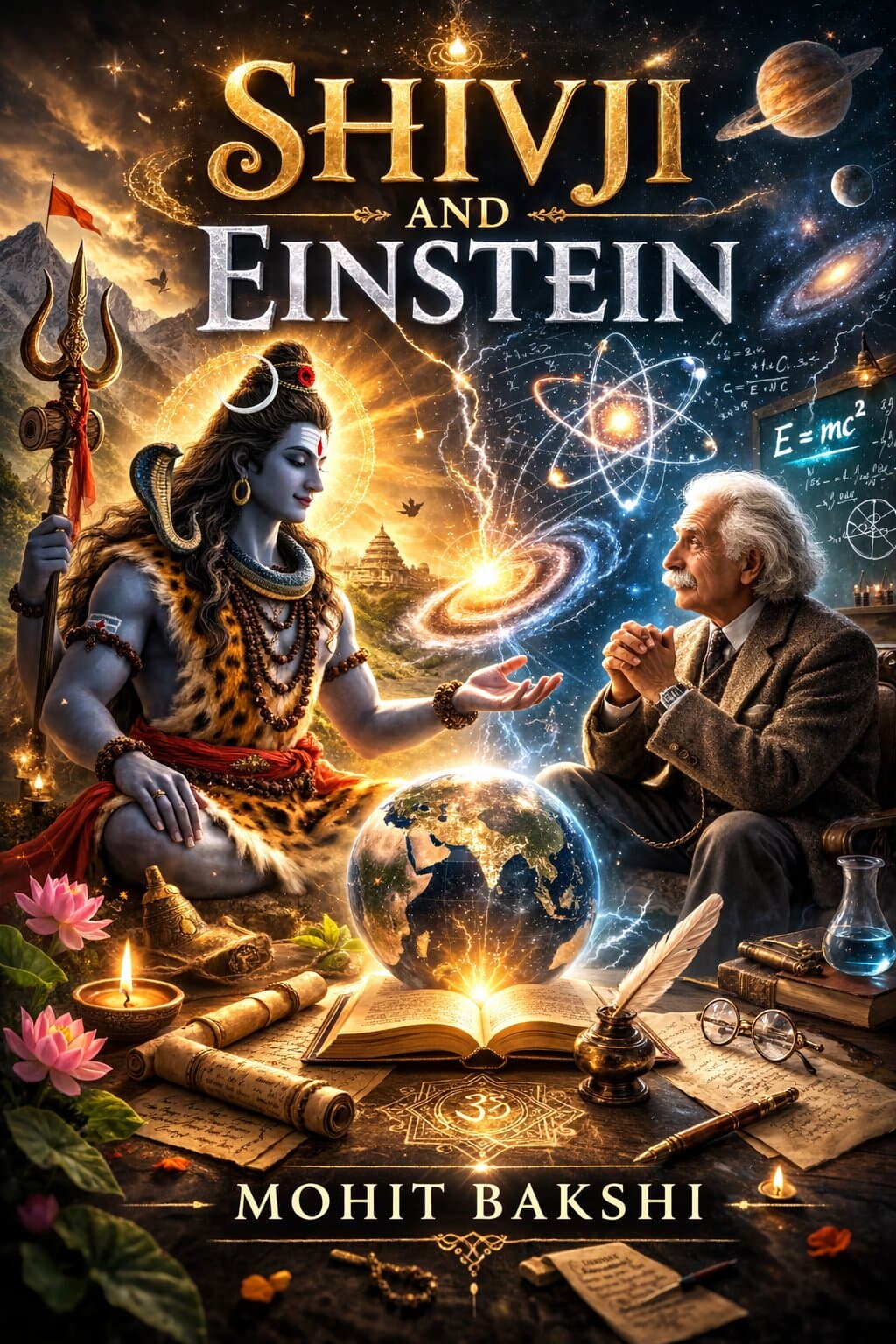
# **Shivji and Einstein: A Cosmic Peer Review**
### Synopsis (Approx. 800 Words)
The story **”Shivji and Einstein: A Cosmic Peer Review”** is a unique blend of science, spirituality, philosophy, and imagination that transcends the boundaries of time, culture, and human understanding. It presents an extraordinary encounter between two of history’s most profound seekers of truth: **Lord Shiva**, the eternal cosmic consciousness of Hindu philosophy, and **Albert Einstein**, the revolutionary physicist whose theories transformed humanity’s understanding of space, time, and the universe.
The narrative begins after Einstein’s earthly journey has ended. Freed from the limitations of the physical world, his consciousness awakens in a mysterious cosmic realm that exists beyond space and time. Here, conventional laws of physics no longer apply. Stars appear as living thoughts, galaxies swirl like rivers of consciousness, and time itself flows in multiple directions. Despite having spent a lifetime unraveling the secrets of the universe, Einstein finds himself confronted with mysteries far greater than anything he encountered on Earth.
Guided by an unseen force, Einstein arrives at **Mount Kailash**, not merely as a geographical location but as the metaphysical center of existence. There, seated in serene meditation amidst a boundless cosmic landscape, is Lord Shiva. His presence embodies both infinite stillness and infinite dynamism. Around him dance the energies of creation, preservation, and destruction, symbolizing the eternal cycles governing the cosmos.
What follows is not a confrontation between science and religion but a profound dialogue between two seekers approaching the same truth from different directions. Einstein presents the achievements of modern physics—relativity, spacetime, gravity, and the quest for a unified theory of nature. Shiva listens with compassionate curiosity, acknowledging humanity’s remarkable progress in deciphering the external workings of reality.
As their conversation unfolds, Einstein discovers that many concepts he struggled to express mathematically have philosophical parallels within ancient spiritual traditions. Shiva explains the cosmic dance of **Nataraja**, revealing it as a symbolic representation of the perpetual motion and transformation underlying existence. Einstein recognizes echoes of quantum uncertainty and cosmic evolution within this timeless imagery.
The dialogue gradually deepens into questions about the nature of time. Einstein, famous for redefining time as a dimension intertwined with space, is intrigued when Shiva describes time not as a linear progression but as a manifestation of consciousness itself. Past, present, and future are portrayed as interconnected layers of a greater reality, perceived differently depending on one’s state of awareness.
The discussion then turns toward the origins of the universe. Einstein reflects on humanity’s theories regarding the birth of the cosmos, from the Big Bang to modern cosmology. Shiva responds by introducing the concept of cyclical creation and dissolution, where universes emerge, evolve, dissolve, and are reborn endlessly. The universe is not portrayed as a one-time event but as part of an eternal rhythm that transcends human notions of beginning and end.
As the conversation progresses, Einstein begins to confront questions that science alone cannot fully answer. What is consciousness? Why does the universe possess order and beauty? Is reality fundamentally material, or does consciousness play a deeper role in its existence? Shiva reveals that consciousness is not merely a product of matter but a fundamental aspect of reality itself. The physical universe is described as a manifestation arising within a deeper field of awareness.
The narrative introduces a fascinating concept called the **”Cosmic Peer Review.”** In earthly science, peer review is the process through which ideas are tested, challenged, and refined. In the cosmic realm, however, every belief, theory, and perception undergoes a similar examination. Einstein realizes that even the greatest scientific theories are stepping stones rather than final truths. Likewise, spiritual insights must continually evolve through experience and understanding.
Throughout this cosmic review, neither science nor spirituality is declared superior. Instead, both are shown as complementary paths toward understanding reality. Science excels at exploring the external universe through observation and experimentation, while spirituality investigates the inner dimensions of consciousness through introspection and experience. Together, they form a more complete picture of existence.
A particularly powerful moment occurs when Shiva grants Einstein a vision of the universe beyond ordinary perception. Einstein witnesses galaxies being born and dying, dimensions unfolding within dimensions, and consciousness permeating every aspect of creation. He sees that mathematical equations, while beautiful and powerful, represent only one language through which the cosmos expresses itself. Art, music, meditation, and love are revealed as equally valid pathways to understanding the mysteries of existence.
The story reaches its climax when Einstein recognizes that the ultimate truth cannot be fully captured by formulas, words, or symbols. Every model of reality is necessarily incomplete because reality itself is infinite. Yet this realization does not diminish the value of science; rather, it elevates it. The pursuit of knowledge becomes a sacred journey rather than a quest for final answers.
In the end, Einstein leaves the cosmic encounter transformed. He retains his passion for reason and inquiry but gains a deeper appreciation for the dimensions of reality that lie beyond empirical measurement. Shiva’s final message emphasizes humility, curiosity, and unity: the universe is not divided between science and spirituality but encompasses both within a greater whole.
**”Shivji and Einstein: A Cosmic Peer Review”** is ultimately a celebration of humanity’s eternal search for truth. Through the meeting of a modern scientific genius and an ancient cosmic deity, the story explores profound questions about consciousness, time, existence, and the limits of knowledge. It invites readers to embrace both rational inquiry and inner wisdom, suggesting that the deepest understanding of reality emerges when science and spirituality work together rather than in opposition. The result is a thought-provoking and inspiring tale that encourages readers to see the universe not merely as an object to be studied, but as a mystery to be experienced.