Welcome to BSME2E
Live
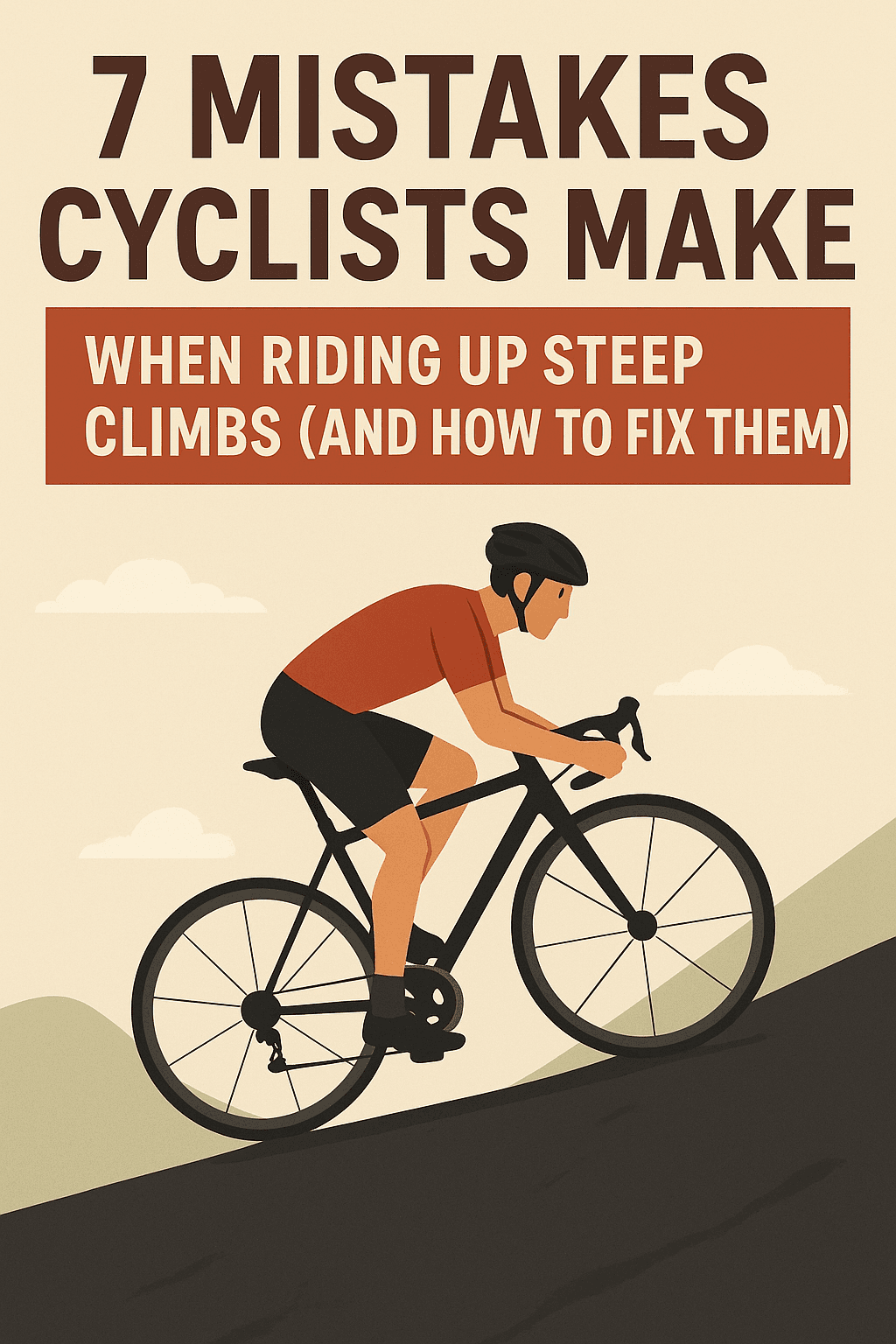
When it comes to cycling, few challenges test your endurance, technique, and mental strength quite like a steep climb. Some cyclists seem to float uphill as if gravity doesn’t apply to them, while the rest of us end up gasping, grinding, or even walking our bikes halfway up.
The good news? Most climbing struggles are not simply about being “fit enough.” Instead, they often come from small, avoidable mistakes—things we might not even realize we’re doing wrong. By identifying and correcting these errors, you’ll not only make climbing easier but also more enjoyable.
Let’s break down the 7 most common climbing mistakes and how you can fix them, with extra notes, pro tips, and beginner insights along the way.
At the base of a climb, you’re fresh, the adrenaline is pumping, maybe you’re trying to keep up with a group… and suddenly you’re attacking the hill like it’s a 200m sprint.
The problem? Your legs will betray you about halfway up. Muscles flood with lactic acid, your breathing turns ragged, and the hill feels twice as long as it really is.
Overconfidence at the bottom.
Peer pressure—trying to keep pace with stronger riders.
Misjudging the gradient (it always looks easier from the bottom).
Start conservatively. Begin with a rhythm you know you can sustain. Think of it like slowly turning up the heat, not blasting the gas pedal from the start.
Use a bike computer or GPS app (like Garmin, Wahoo, or Strava maps) to preview the climb. Knowing the gradient and distance in advance prevents panic pacing.
💡 Pro Tip: Imagine you’re running a marathon, not a sprint. If you feel like you’re going too easy at the start, that usually means you’re pacing just right.
You’re grinding your pedals slowly, every turn feeling like you’re forcing the bike uphill by brute strength. Many riders think pushing “big gears” makes them look powerful, but in reality, it’s inefficient and exhausting.
Low cadence puts enormous strain on your knees and quads.
It wastes energy that could be better conserved.
It leads to premature muscle fatigue—even before you hit the steepest sections.
Shift early. Anticipate the slope and drop into easier gears before you feel the strain.
Aim for a cadence of 70–90 rpm. This keeps the pedalling smooth and efficient.
Don’t be afraid to “spin” in an easier gear—it’s not weakness, it’s smart riding.
💡 Note: Some riders like the “grind,” claiming it builds strength. That’s fine for short climbs or advanced riders training specific muscles—but for everyday cyclists, spinning is the healthier and faster approach.
You hit the steepest part of the hill, panic, and suddenly slam your shifters in desperation. The chain clunks, skips, or even drops, and you lose all momentum.
This is one of the most common rookie errors—waiting too long to shift.
Always look ahead. If you see the gradient steepening, shift before you need to.
Practice “pre-shifting” on flatter roads to get comfortable with how your bike responds.
On really steep climbs, downshift just before hairpins or corners where the gradient usually spikes.
💡 Pro Tip: Think of gear shifting like drinking water. You don’t wait until you’re desperately thirsty—you drink steadily before you’re in trouble.
You lock into one position—hands fixed, back stiff, seated the entire way—and expect your body to keep pushing efficiently.
Cycling is about fluidity, not stiffness. When you freeze in place, your muscles fatigue faster because you’re not allowing other groups to share the workload.
Change hand positions: tops, hoods, drops (on road bikes).
Slide slightly forward or backward on the saddle to engage different muscles.
Alternate between sitting and standing every now and then—don’t wait until you’re dying to stand.
💡 Note: Moving around isn’t just about muscles—it also improves breathing. A small posture change can open your diaphragm and let you get more oxygen.
Some cyclists treat every climb like a dance floor—constantly standing, rocking the bike side to side. It looks dramatic, but standing uses 10% more energy than seated climbing.
On very steep pitches where sitting isn’t sustainable.
To “stretch out” your muscles during long climbs.
For short bursts to power over an obstacle.
Stay seated for as much of the climb as possible.
Save standing for when it truly matters—like steep hairpins or to give your back/hips relief.
If you stand, shift up one gear (harder) to avoid spinning out too fast.
💡 Pro Tip: Mix it up. I like sitting 90% of the time but standing every few minutes for 10–15 pedal strokes. It keeps me fresh and mentally breaks the climb into segments.
You start the climb with empty tanks, or worse—you try to stuff food in your mouth halfway up. By the time that gel or bar kicks in, the climb is already over and you’ve suffered unnecessarily.
Climbing is glycogen-heavy work. If your energy stores are low, your power output collapses.
Eating at the wrong time (like mid-ascent) doesn’t help immediately—it just messes with your breathing.
Eat a light snack (banana, energy bar, or dates) about 30 minutes before the climb.
Sip water steadily before and during the climb, not just when you’re desperate.
For rides over 2 hours, use a mix of carbs + electrolytes so you don’t bonk.
💡 Note: Nutrition is personal. Experiment on training rides to see what sits well with your stomach.
You see the summit and decide it’s time to “go hero mode.” You stand, shift into a heavier gear, and hammer… only to blow up right before the crest, crawling over the top slower than if you’d just kept your rhythm.
Stay calm and consistent. Spinning wins over surging almost every time.
Treat the summit as just another part of the climb—ride smoothly through it.
If you want to push, do it only in the last 20 meters, not the last 200.
💡 Pro Tip: Save your energy for the descent. Climbing is about efficiency, but descending is where you can enjoy the reward.
Climbing isn’t just legs—it’s a battle of the mind. Telling yourself “I can’t do this” is one of the biggest mistakes you can make.
Break the climb into sections—focus on the next corner, not the whole mountain.
Use a steady rhythm like a mantra: pedal-breathe-pedal-breathe.
Remember: even the best climbers suffer—it just looks easier because they’ve trained their bodies and minds to endure.
Climbing hills efficiently is more about brains than brawn. Avoid these common mistakes and you’ll find that hills become less intimidating and far more manageable.
Don’t sprint the bottom.
Don’t mash giant gears.
Don’t wait too long to shift.
Don’t lock yourself into one position.
Don’t stand constantly.
Don’t fuel at the wrong time.
Don’t blow up at the summit.
Each climb is an opportunity to refine your technique, train your patience, and discover how strong you really are.
Remember: the goal isn’t just reaching the top—it’s reaching the top with enough energy left to enjoy the ride down.
After all, what goes up must come down—and that’s where the real fun begins.