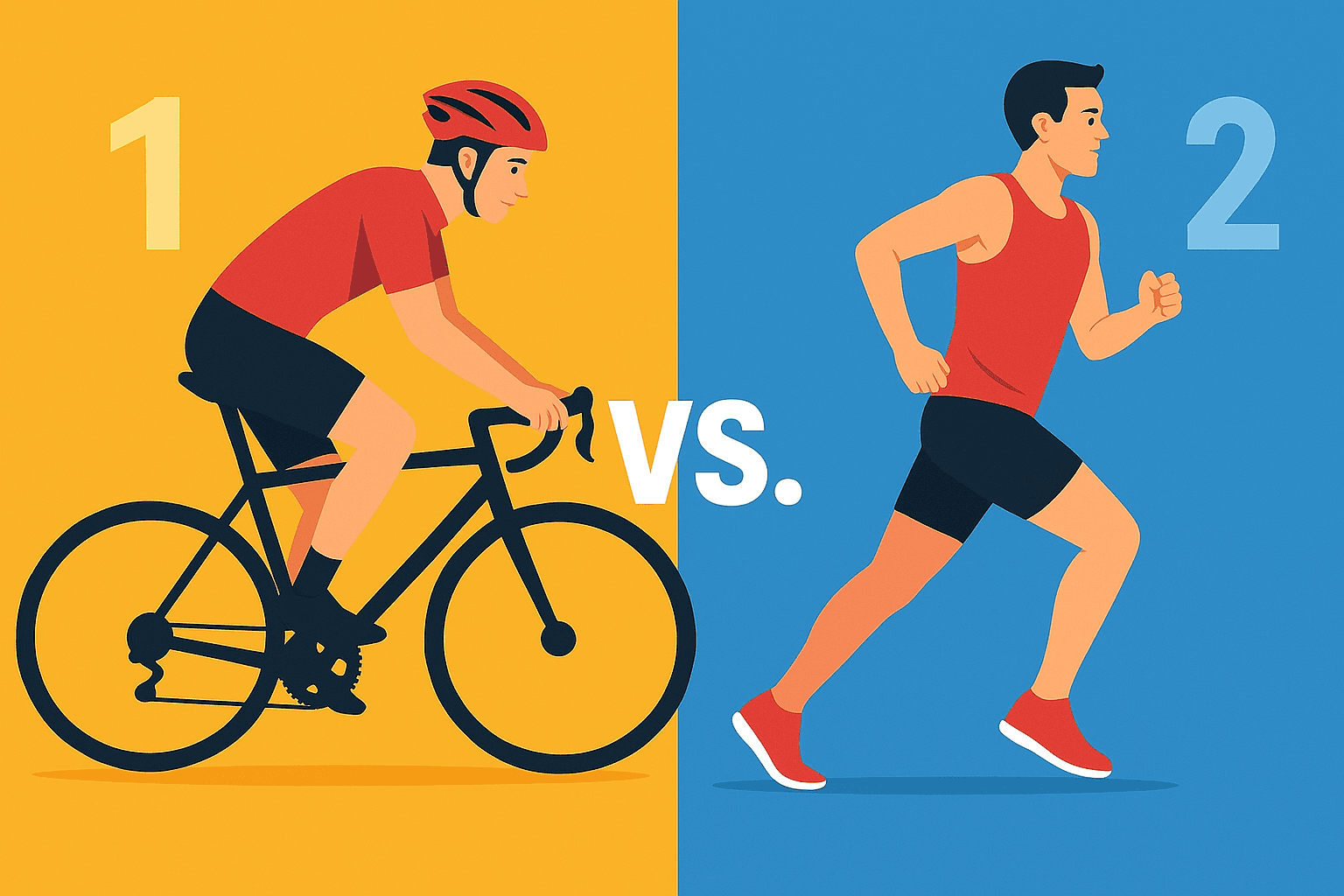
It’s one of the oldest debates in fitness circles — almost as hotly contested as the “pineapple on pizza” question: which is better for your body and fitness — cycling or running?
At first glance, both seem similar. They’re cardio-heavy, they get your heart rate up, burn calories, and work the lower body. But the truth is, each has unique benefits, drawbacks, and contexts where one might shine more than the other.
Instead of choosing one blindly, let’s break this down properly. By the end, you’ll know exactly which activity suits your goals, lifestyle, and body better.
1. Calorie Burn: Who Wins the Numbers Game?
When people ask “Which is better?” most of the time, they’re really asking: “Which burns more calories?”
Running:
-
A 30-minute run at a moderate pace (say 6 mph / 10 min per mile) burns roughly 300–330 calories for an average adult.
-
Running is efficient for calorie burning because your entire body weight is carried with every step — it’s like resistance plus cardio in one.
Cycling:
-
A 30-minute ride at a moderate pace (12–14 mph / 19–22 km/h) burns 240–260 calories.
-
At higher intensities (say uphill climbs or fast sprints), cycling can burn much more — up to 500–700 calories an hour depending on effort.
The twist: Cycling usually allows you to go for much longer without feeling destroyed. Many people can’t run for two hours straight, but they can cycle for that long. That means while running may burn more in the short burst, cycling often racks up higher total calorie burn over time.
👉 Note:
If you’re short on time and want the fastest calorie burn, running wins. If you want to sustain longer workouts and still torch fat, cycling has the edge.
2. Joint Impact: Your Body’s Future Self Will Thank You
This is where cycling absolutely shines.
Running:
Every step is essentially a mini-impact event. Studies suggest your knees and ankles absorb forces up to 2–3 times your body weight with each stride. That’s not necessarily bad — it helps build stronger bones (more on that later) — but it can also lead to shin splints, knee pain, and overuse injuries, especially if form and shoes aren’t optimal.
Cycling:
Cycling is a low-impact exercise. Your weight is supported by the saddle, meaning your joints don’t have to absorb the shock of impact. That’s why people with arthritis, knee issues, or recovering from injury often choose cycling over running.
👉 Note:
If you want longevity, minimal pain, and the ability to train more days a week, cycling is far more joint-friendly. Running is great for resilience, but it can wear you down if not carefully managed.
3. Muscle Development: Toning vs Strengthening
Both workouts target the lower body, but the muscle activation differs.
Running:
-
Primarily tones quads, hamstrings, calves, and glutes.
-
Strength is built more through repetition and endurance rather than resistance.
-
Upper body also gets engaged — arms pump, core stabilizes — giving a more balanced full-body effect.
Cycling:
-
Works quads, hamstrings, calves, and glutes, but at higher resistance.
-
Especially powerful for developing quadriceps due to pushing against the pedals.
-
Sprinting uphill or in a heavy gear gives a strength-training-like burn.
-
Upper body is less engaged compared to running, though your core works hard to stabilize.
👉 Note:
Want lean muscle tone across your body? Running is better. Want stronger, more defined legs and glutes? Cycling gives you the advantage.
4. Bone Density: The Hidden Health Factor
This one often gets overlooked, but it’s crucial — especially as we age.
Running:
Cycling:
-
Because it’s low impact, cycling doesn’t provide the same bone-strengthening benefits.
-
Cyclists who don’t do weight training sometimes show lower bone density compared to runners.
👉 Note:
If you rely solely on cycling, pair it with strength training or impact-based cross-training (like skipping, jogging, or even bodyweight jumps). Runners get bone-strength benefits built-in, but must be cautious of stress injuries.
5. VO₂ Max and Cardiovascular Fitness
VO₂ max measures how efficiently your body uses oxygen during intense exercise. It’s a gold standard for cardiovascular fitness.
-
Runners: Often show higher VO₂ max when tested in running-specific environments. Running’s weight-bearing nature challenges the body more intensely in shorter bursts.
-
Cyclists: Can often sustain higher intensities longer, since cycling puts less total strain on the joints. Long-distance cyclists typically show excellent VO₂ max values too — but they’re sport-specific.
👉 Note:
Both improve heart health massively. Running builds intensity and peak effort, while cycling builds endurance and stamina.
6. Weight Loss: Who Helps You Slim Down Faster?
Both are fantastic for weight management, but here’s the breakdown:
-
Running: Burns calories faster per minute. Great if your goal is quick weight loss in shorter sessions.
-
Cycling: Lets you train longer, more consistently, and more frequently without needing as much recovery. That consistency helps with gradual, sustainable fat loss.
👉 Note:
For short-term fat burn → Running.
For long-term sustainable fat loss → Cycling.
7. Suitability for Beginners: Which Is Easier to Start?
Running:
-
All you need is a good pair of shoes.
-
Natural movement — you’ve been running since childhood.
-
But it’s harder on the body, meaning beginners often burn out or get injured quickly.
Cycling:
-
Requires a bike and some gear (helmet, maybe padded shorts), which can be an upfront cost.
-
However, it’s gentler on beginners — less stress, less soreness, easier to build up time.
👉 Note:
If you want the easiest start, running wins on simplicity. If you want a smoother, safer entry into fitness, cycling is kinder on the body.
8. Lifestyle & Practicality: Which Fits Better Into Daily Life?
This is often ignored but is hugely important.
-
Running: Super practical — just lace up your shoes and step outside. Great for travellers, busy people, or those without access to a bike.
-
Cycling: Can be integrated into commuting. Cycle to work, to school, or for errands, and you get exercise and transportation in one. Research shows cycle commuters are often happier and more productive at work.
👉 Note:
If time is short, running may fit easier. If you want a sustainable, practical way to exercise daily, cycling has big lifestyle advantages.
9. Mental Health & Fun Factor
-
Running: Meditative, rhythmic, often associated with “runner’s high.” Great for clearing the mind.
-
Cycling: Offers more adventure — you can travel far, explore new areas, and enjoy group rides. Social cycling communities are strong motivators.
Which is Better?
The truth is — neither is “better” in absolute terms.
It all depends on your goals:
-
For calorie burn and bone health → Running wins.
-
For joint safety, endurance, and long-term sustainability → Cycling wins.
-
For beginners → Running is simpler, cycling is easier on the body.
-
For lifestyle integration → Cycling can double as transport.
At the end of the day, the best exercise is the one you’ll actually do consistently. Whether you’re a two-wheels warrior or a two-feet fighter, the key is movement.
👉 Don’t pick one forever — try both. Use running for intensity and bone health, cycling for endurance and fun. Together, they form one of the best fitness combos possible.