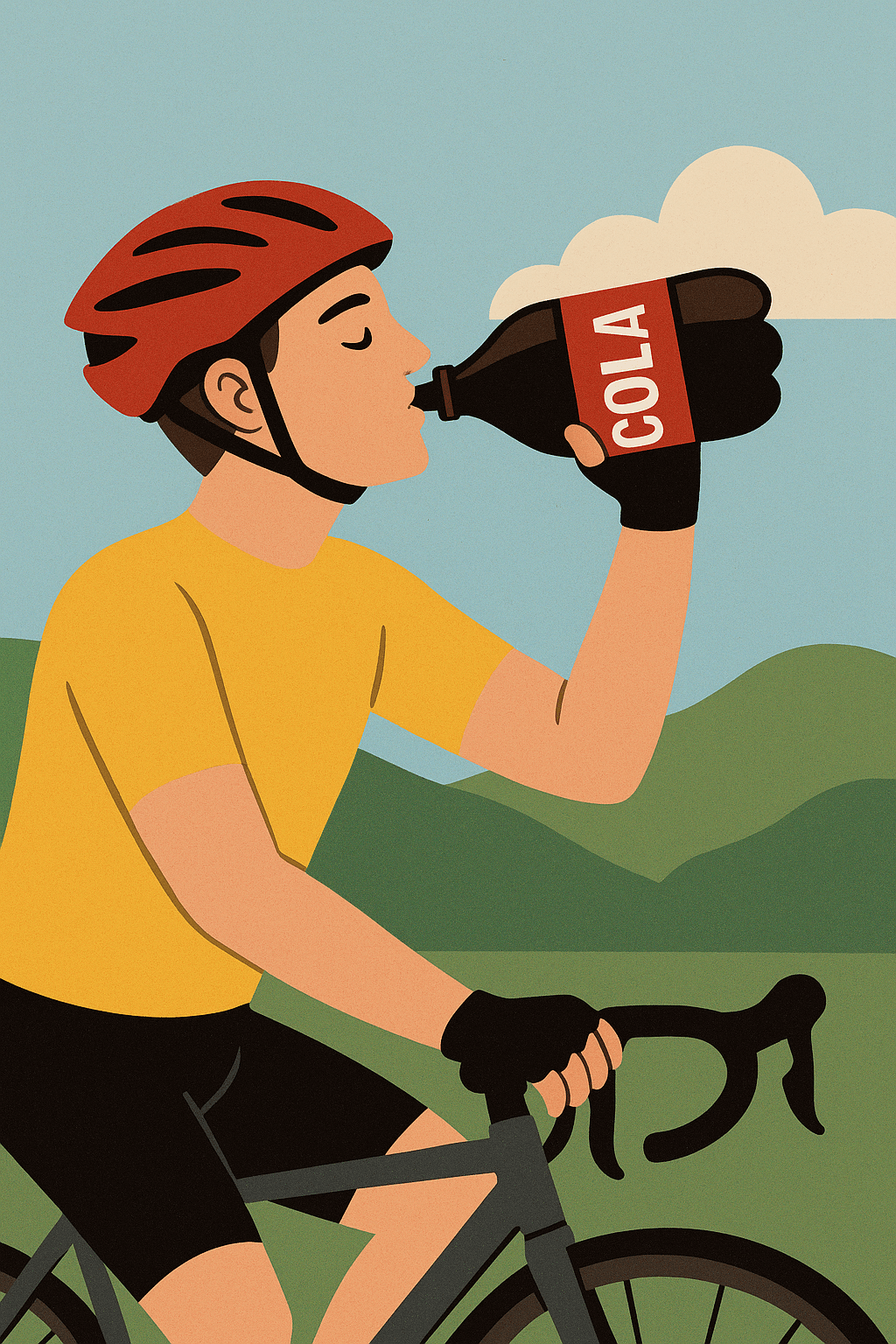
(Why that cold can of Coke isn’t just a guilty pleasure — it’s a smart mid-ride strategy.)
Let’s be honest: there’s something almost magical about cracking open a can of cola when you’re 80 kilometers deep into a hot, gruelling ride.
That hiss of carbonation. The rush of sweetness. The sudden spark of energy that makes your tired legs remember what they were built for.
It’s not just in your head. There’s real science behind why so many cyclists — from weekend warriors to Tour de France pros — swear by cola mid-ride.
It’s not about taste or nostalgia. It’s about chemistry, timing, and how your body responds to sugar and caffeine when fatigue sets in.
Let’s unpack this bubbly phenomenon and see why that simple soda has earned a place in the cyclist’s toolkit.
🧪 Why Cola Works: The Perfect Combo of Sugar + Caffeine
After two or more hours in the saddle, your glycogen stores — the body’s “battery” for endurance — start running dangerously low.
Your muscles begin crying out for quick, easily digestible energy. And your brain, deprived of glucose, starts whispering: “Stop pedalling. Sit down. You’re done.”
That’s when cola becomes your superhero in a red cape.
Here’s why:
| Ingredient |
Function |
What It Does for Cyclists |
| Sugar (glucose + fructose) |
Rapid energy |
Quickly replenishes depleted glycogen stores and powers your working muscles |
| Caffeine |
Mental + physical stimulant |
Boosts alertness, reduces perceived exertion, and encourages fat utilization |
| Carbonation |
Slight GI stimulant |
Helps settle mild stomach discomfort and speeds gastric emptying for faster absorption |
| Sodium (in small amounts) |
Electrolyte |
Aids hydration and muscle contraction |
Each 330ml can of cola contains roughly 39 grams of sugar and about 32–35mg of caffeine — not extreme, but just enough to wake up your muscles and mind.
💡 Fun Fact: Studies show caffeine can improve endurance performance by 2–5%, even in small doses, which is why many cyclists save their “cola shot” for the final push.
🧬 The Science: Real Studies Back It Up
You might be surprised that sports scientists have actually studied Coke as a performance enhancer — and the results are fascinating.
A landmark research paper titled
“Effect of different protocols of caffeine intake on metabolism and endurance performance”
looked at how caffeine and sugar intake (specifically through cola) impacted cyclists during long rides.
Here’s what the studies revealed:
-
Study A:
12 trained cyclists were given 2 × 5ml/kg of Cola during the last 40 minutes of a 2-hour steady-state (SS) ride followed by a time trial (TT).
🔹 Result: Time trial performance improved by 3.1% compared to no-caffeine trials.
-
Study B:
8 cyclists consumed a caffeinated 11% carbohydrate Cola in the final 40 minutes of a similar endurance session.
🔹 Result: Performance improved by 3.3%.
📊 Conclusion:
Replacing your usual sports drink with cola in the final stages of a long ride gives comparable or even superior endurance benefits, largely because of its fast sugar absorption and mild caffeine boost (around 1.5 mg/kg body weight).
⚖️ Cola vs. Traditional Sports Drinks
Let’s break down the pros and cons compared to standard cycling fuels.
| Feature |
Cola |
Sports Drink |
| Carbs (per 330ml) |
39g (mostly simple sugars) |
20–25g (mix of simple + complex carbs) |
| Caffeine |
32–35mg |
Often none, or 25–75mg (varies) |
| Electrolytes |
Minimal |
Usually balanced (Na, K, Mg) |
| Energy Absorption Speed |
Very fast |
Moderate |
| Taste + Enjoyment Factor |
Sweet, familiar, refreshing |
Functional, sometimes bland |
| Best Use |
Mid-to-late ride energy rescue |
Sustained energy throughout ride |
🧠 Key takeaway:
Sports drinks are great for maintaining steady energy levels.
But when you hit the wall, cola acts like a turbo button — flooding your bloodstream with glucose and caffeine just when you need it most.
🕒 When and How to Use Cola on a Ride
Cola isn’t meant to replace your regular hydration and fuelling — it’s a strategic weapon.
Timing and portion control make all the difference.
✅ When to Drink It
-
During the last 25–40 km of a long endurance ride or race.
-
When your usual energy gels feel heavy or you can’t stomach another bar.
-
Right before a major climb or sprint finish.
⚠️ When Not to Drink It
-
At the start of your ride — it’ll spike your blood sugar too early, causing a crash later.
-
On short (<60 min) rides — your body doesn’t need it yet.
-
When dehydrated — cola lacks electrolytes, so drink water or a sports mix alongside.
💧 How Much to Take
🧊 Bonus Tip:
Chilled cola works wonders on hot days — it cools your core temperature and refreshes your senses instantly.
🥤 Cola Alternatives Worth Considering
Not a fan of traditional Coke? No problem. You can get the same benefits from other sources:
-
Natural Cola variants – organic cola drinks with real cane sugar or natural caffeine.
-
Caffeinated sports drinks – like Tailwind Caffeinated or SIS Beta Fuel + Caffeine.
-
Energy gels with caffeine – compact and easy to carry, though less refreshing.
-
Maple water or coconut water with espresso shot – DIY natural endurance fuel.
-
Cold coffee + electrolyte drink mix – great for long hot rides.
🔍 Note: Some cyclists even mix cola half-and-half with water or isotonic drinks to reduce sugar concentration while keeping that caffeine kick.
⚠️ Important Considerations
Like any tool, cola works best when used strategically, not excessively.
1. Don’t Rely on It for Every Ride
Cola is rescue fuel, not your everyday nutrition plan. Overusing it may cause sugar dependency and GI distress on long rides.
2. Watch the Carbonation
Some riders love the fizz — it helps burp out stomach gas and reduces bloating.
Others hate it — it causes discomfort during climbs. Try both and see what works for you.
3. Mind Your Teeth
Cola is acidic and sugary, so rinse your mouth with water after drinking to protect your enamel, especially during multi-hour rides.
4. Pair with Water or Electrolytes
Since cola lacks sodium and potassium, always chase it with a sip of water or an electrolyte mix.
5. Don’t Drink the Whole Bottle
A little goes a long way. Too much sugar at once can spike insulin and cause a rebound crash mid-ride.
🧩 Real-World Example: Pro Cyclists Do It Too
If you’ve ever watched the Tour de France, you’ve likely seen soigneurs (team helpers) handing cans of Coke to exhausted riders during the final climbs or time trials.
Even pros who train with precision fuelling plans still use cola as their “emergency turbo fuel.”
💬 “After five hours, nothing tastes better than a Coke,” said one World Tour rider.
“It wakes you up, lifts your spirits, and gets your legs firing again.”
So, if the best in the world trust it for that final push, there’s definitely something in the science — and the sensation.
🏁 The Art of Cola Timing
Cola isn’t a miracle drink — it’s a finely timed tool for when fatigue, hunger, and dehydration converge.
Used wisely, it can give you that 3–5% performance edge when it matters most.
Think of it as:
-
A mental reset button for your focus,
-
A quick energy refill for your muscles, and
-
A cooling reward that keeps you rolling strong to the finish.
So next time you’re out on a long ride, tuck a mini can of cola in your jersey pocket or plan a café stop that serves it chilled.
When the miles start biting and motivation fades, that red can might just save your ride.
Because sometimes… science tastes a lot like happiness in a can. 🥤✨