BSMe2e · Global Hall of Fame · Living Time Capsule
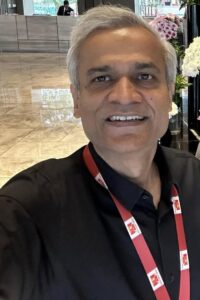
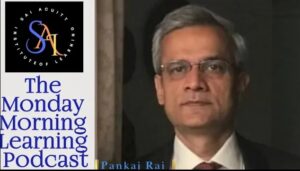
PANKAJ RAI: THE SILENT FORCE BEHIND THE NUMBERS
In every era, there are leaders whose influence quietly exceeds their visibility. They do not occupy the loudest rooms. They shape what happens inside them. Their thinking outlasts the decisions it informs. Their frameworks survive the organizations that first used them. And their most significant contribution is rarely a single achievement; it is the accumulated judgment of a life examined with uncommon honesty.
Pankaj Rai is precisely this kind of leader.
Over three decades spanning global banking, multinational technology, and large-scale conglomerates, he has watched data evolve from a department into the central nervous system of modern enterprise. He did not merely ride that wave. He stayed one step ahead of it, building not just a career but a constellation of frameworks forged from real experience, lived transitions, and the willingness to ask harder questions than most leaders dare to confront.
BSMe2e inducted him as its first Global Hall of Fame Champion and Living Time Capsule because what Pankaj carries does not belong only to him. It belongs to every leader who will face what he has already navigated, and will need something more reliable than instinct to find their way through.
A Beginning Written in the Stars
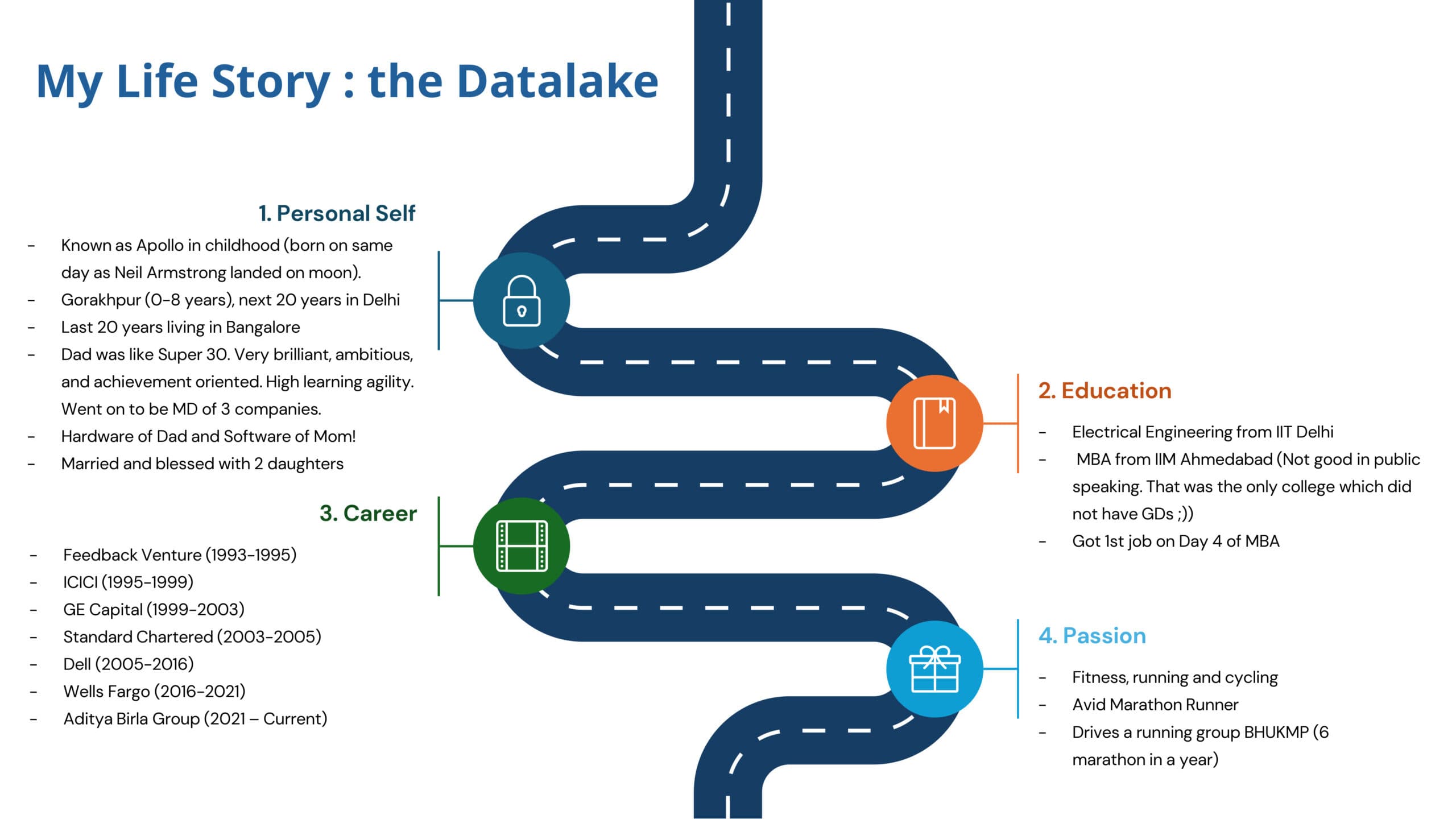
The symbolism of Pankaj Rai's beginning is almost too perfect to have been planned. He was born on the twenty-first of July, 1969, the day Neil Armstrong set foot on the moon. Two days earlier, Indira Gandhi had nationalized fourteen of India's major commercial banks. In the space of forty-eight hours, India had closed one door, and the world had opened another. His grandfather, a man who worked for the Railways, looked at the newborn and made a decision. Apollo. Not after the mission, exactly. After the spirit of it, the idea that a human being could be aimed at a destination that had never been reached before and could land.
His childhood was shaped by parental aspiration, quiet discipline, and a curiosity that had not yet found its proper channel. His father had risen from a small village to IIT Bombay and held education as a form of leverage.
That belief was passed on without hesitation, guiding Pankaj toward IIT Delhi, where he pursued Electrical Engineering. His early years were also shaped by the FCI colony, a Fertilizer Corporation of India township, where he spent time with his father, where neighbors were a Sadhu, a Malayali, a Punjabi, and a Bengali. He did not know, for years, that they were from different regions at all. The diversity installed something in him that no examination would test.
IIT Delhi gave him the discipline of precision. An MBA from IIM Ahmedabad opened an entirely different world, one built around decision-making, trade-offs, and the often unglamorous reality of how organizations actually function beneath the language of strategy.
From Engineering to Insight: The Early Career
At each junction of his early career, Pankaj chose depth over safety. He joined Feedback Ventures, a startup consulting firm, when a more predictable role was available. Sudip Mukherjee, who worked alongside him in those early days, noted that what was visible was not Pankaj's output but his process, the careful listening, the question underneath the assumption, the curiosity that felt almost innocent in its consistency.
He moved to ICICI to develop genuine business fluency from the inside. Sandeep Bakshi recalibrated him in one sentence: "You've been offering advice which is free. We give loans. We make two rupees on a good loan. We lose one hundred on a bad one. Think about fifty-to-one odds." That asymmetry of consequence is embedded in every framework Pankaj would later build.
He joined GE Capital, where he encountered DMAIC: Define, Measure, Analyze, Improve, Control. Six Sigma gave him something most intellectual frameworks do not: a language for the difference between causes and symptoms. Then came an assignment that would quietly reshape his understanding of enterprise: as a core team member helping create the business plan for GE's offshoring arm, GECIS, the organization the world would later come to know as Genpact.
To be present at the formation of an industry, to understand its logic before it had fully declared itself, left a mark that exposed him to the BPO world and expanded his scope in ways no classroom could have replicated.
Standard Chartered, Dell, and the Art of Building
Pankaj's move to Standard Chartered Bank via Singapore marked a genuine shift in register, from participation to creation. These years sharpened his ability to design organizations rather than simply occupy roles within them.
A turning point arrived when Romi Malhotra invited him to Dell. What began as a strategic assignment deepened into a nine-year journey in analytics leadership.
A senior Dell leader named Jay, watching Pankaj's banking-shaped instincts at work, made a calculation: Given that you have a banking and finance background, why don't you set up the DFS analytics team? I wasn't trying to be an analytics person, Pankaj would say later. Jay saw something I hadn't named yet. That catapulted me into the field of analytics.
As analytics became increasingly technical, he recognized that his management-oriented strengths were less aligned with the field's new demands. Rather than resist that shift, he stepped aside from identity and leaned into learning. Calmly. Deliberately. Without fear of not knowing. This quality, the willingness to acknowledge a gap and move toward it rather than away from it, is not common among leaders at his level.
Wells Fargo and the Digital Reinvention
After Dell, Pankaj joined Wells Fargo. Initially placed in a familiar strategy role, he was soon asked to build a digital product management team, an entirely different ecosystem of language and execution. He learned it the same way he had learned everything else: methodically, without performance anxiety. This consistency across contexts is what separates career development from career construction. Pankaj was always constructing.
This adaptability ultimately brought him back to India in 2005, when he joined the Aditya Birla Group as Group Chief Data and Analytics Officer. The decision was intentional. He wanted proximity to influence, to context, to the purposeful work of shaping outcomes within one of India's most consequential business institutions. He named the new era GDA 2.0, honoring the work that had come before while bringing his own distinct culture and stamp.
The Frameworks: Operating Systems for Life and Work
For Pankaj Rai, frameworks are not abstractions. They are operating systems. Each one carries the marks of real experience, forged not in academic isolation but through the friction of lived transition.
THE SEEE FRAMEWORK
SEEE governs daily life with quiet rigor. Sleep is first, eight to nine hours, non-negotiable. Eating is calibrated to maintain consistent energy across endurance sports. Exercise spans marathons, cycling, badminton, and gym work. Expression, his term for the mental and emotional interior, is not treated as a separate discipline. He has found that it arrives naturally when the first three variables are properly managed. The framework is not a health protocol. It is a theory of the complete person: one whose physical and expressive capacities are managed with equal rigor.
THE 5C FLYWHEEL
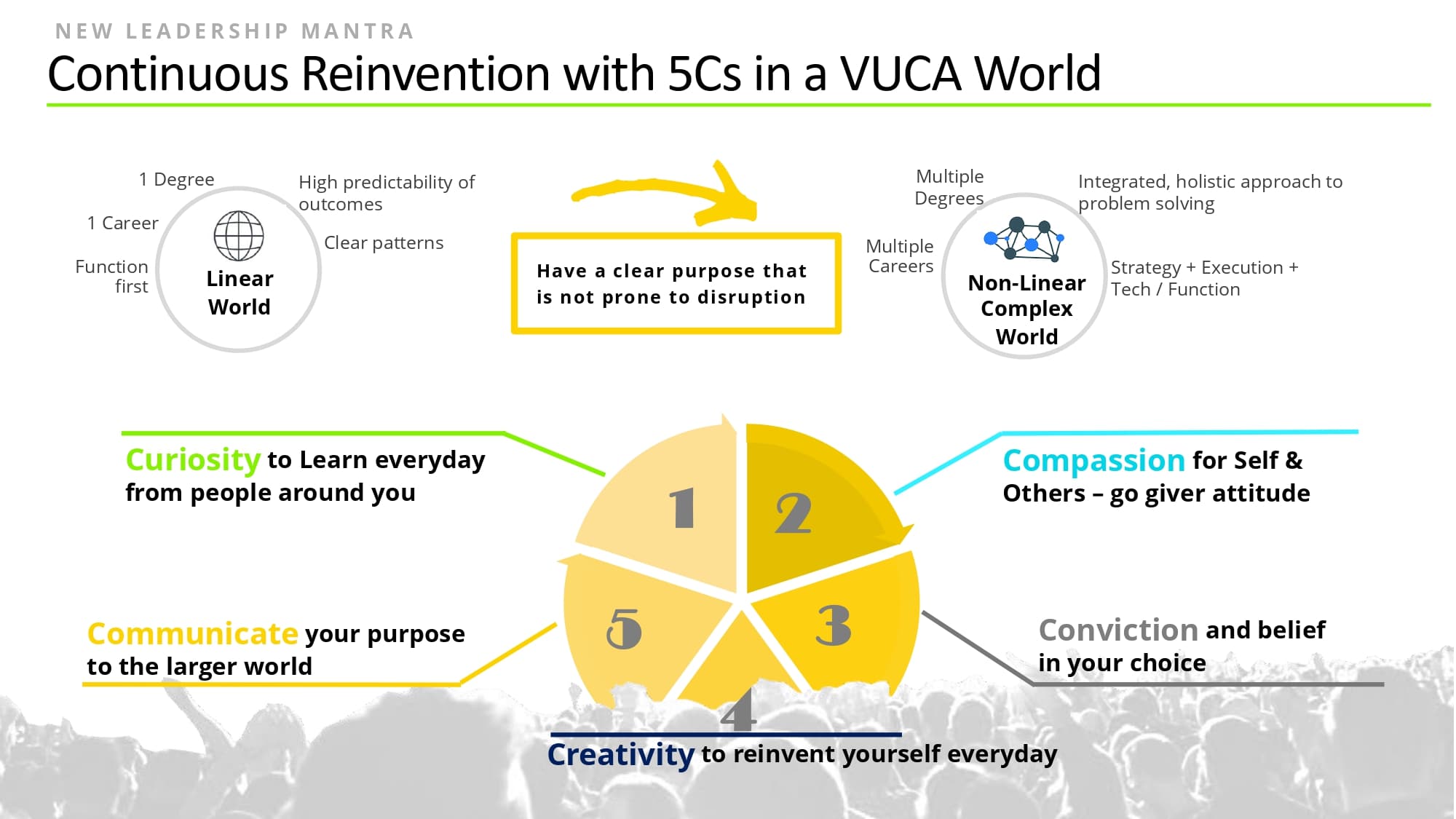
The 5C framework was born at home, when his wife Ritu asked him to help guide their daughters' thinking about careers. Forced to articulate what he had until then practiced by instinct, Pankaj produced a circular model that reflects how leadership actually compounds over time.
Curiosity is the entry point. Compassion is a genuine interest that deepens into care. Conviction is self-belief built through experimentation, not assertion. Creativity is non-linear problem-solving. Communication is the offer, the act of sharing what has been created, which in turn sparks fresh curiosity in others. The framework is circular. Communication feeds back into Curiosity, and the cycle begins again.
"The world has moved from scarcity to abundance. The 5Cs are a compass, not a map."
THE 3P FRAMEWORK: PROCESS → PRODUCT → PURPOSE
Developed from Pankaj's observation of how careers deepen and are urgently sharpened by the arrival of AI in the workplace, the 3P framework describes three levels of engagement with work.
As a Process Owner, you own a deliverable. The core question is: How do I do this well? As a Product Owner, you own an outcome. The question becomes: What should I build? As a Purpose Owner, you own the question of what is worth building. The question is: Why does this matter?
The framework's most important claim is that these stages describe the depth of your engagement with the work, not the height of your position. You can be forty years into a career and still living inside the Process Owner's question. You can be three years out of college and already asking the Purpose Owners.
In 2026, the framework carries a second and more pressing urgency: it is a map for human irreplaceability. Process Owner work is already being automated. Product Owner work is being partially automated. Purpose Owner work, the question of what is worth building, which values should govern the work, and what trade-offs are acceptable, remains structurally irreplaceable. It requires the human capacity to hold competing goods in tension, to make judgments about meaning, and to be accountable in ways that matter morally.
"The only job description that will last your lifetime will be at the purpose level."
THE FREE FRAMEWORK
The FREE framework emerged from Pankaj's study of three generations of women in his own family: his grandmother, his mother, and his wife across a hundred-year arc of change. It applies to everyone, he says, but women need to apply it even more deliberately, because for men, much of it arrives by default.
F is for Finance — financial freedom, meaning earning and investing both. Not partially but entirely: owning the salary, the savings, the investment decisions.
R is for Relationship with Self — the work of building an identity that is not derived from being someone's daughter, wife, or colleague, but built through experimentation and exercised agency.
E is for the physiological essentials: Eating, Exercise, and Sleep, the basket of physical inputs that women, across generations, most readily sacrifice for others.
The last E is Enabling, both being an enabler, which comes naturally, and getting yourself enabled: investing in mentors, networks, and ecosystems with the same intentionality one would bring to any other career decision.
His larger historical argument frames the framework. Across the hunter-gatherer era, the warrior era, and the manufacturing era, men were assigned a single muscular role. Women were assigned the remainder, which is to say, the totality: multiple objectives, simultaneously, with no scoreboard. In the cognitive era, manual jobs have been automated. What remains is cognitive work; IQ and EQ, and in his IIT class, he says, the women were already better at both. The present moment, he argues, represents not merely an opportunity for women but a structural advantage long in the making.
"Confidence compounds. Networks become force multipliers. Independence becomes inevitable."
Networking with Intention
Pankaj defines networking as value exchange, not transaction. His three-step approach: first, share something of genuine value. Second, learn to receive what the other person is genuinely good at, regardless of status. Third, help —respond to actual need rather than perceived leverage. He describes his own journey as a movement from intuition to intention. He was doing things that worked. Now he can do those same things deliberately. That shift from unconscious competence to conscious design is one of the quieter revolutions of a life examined with uncommon honesty.
Measuring a Life
Inspired by Clayton Christensen's lecture How Will You Measure Your Life, Pankaj encourages leaders to imagine their own funerals — not as a morbid exercise, but as a clarifying one. What would people say? And if that answer changes how the question feels, does it also change how one acts?
His 70-20-10 model for personal development reflects this. Seventy percent of growth comes from genuinely doing things. Twenty percent from reflecting on and understanding what was done. Ten percent from offering it to others. Most people, he observes, invert this distribution, spending disproportionate energy on visibility while underinvesting in depth.
70%
Doing
Genuinely doing things
20%
Reflecting
Understanding what was done
10%
Offering
Sharing it with others
A Living Time Capsule
As BSMe2e's first Hall of Fame inductee and Living Time Capsule, Pankaj's message reaches past career accomplishments into something more fundamental. We begin life as variables in other people's equations. Maturity means creating our own. The journey inward precedes the journey outward. Understanding oneself is not a detour from impact. It is the foundation of it.
His career has spanned more than three decades and two countries. He has held senior leadership roles in global banking, multinational technology, and one of India's most consequential conglomerates. He has designed analytics practices from scratch, written business plans that became industries, and built frameworks that will outlive every title he has ever held.
But more than any single achievement, what distinguishes Pankaj Rai is the quality of what he has internalized. The frameworks he carries were not purchased from a consultant. They were earned from a life examined with uncommon honesty and offered to the world with uncommon generosity.
That is why his story belongs in the BSMe2e Hall of Fame Living Time Capsule. Not as a static record of achievement. But as a living reference point for every leader navigating complexity with calm conviction, proof that the most enduring systems are always built from the inside out.
The uniqueness is in execution, not in intention.
"The most enduring systems are always built from the inside out. The uniqueness is in execution, not in intention."
— Pankaj Rai · BSMe2e Global Hall of Fame Champion · First Inductee
Pankaj Rai · BSMe2e Global Hall of Fame · Living Time Capsule · First Inductee