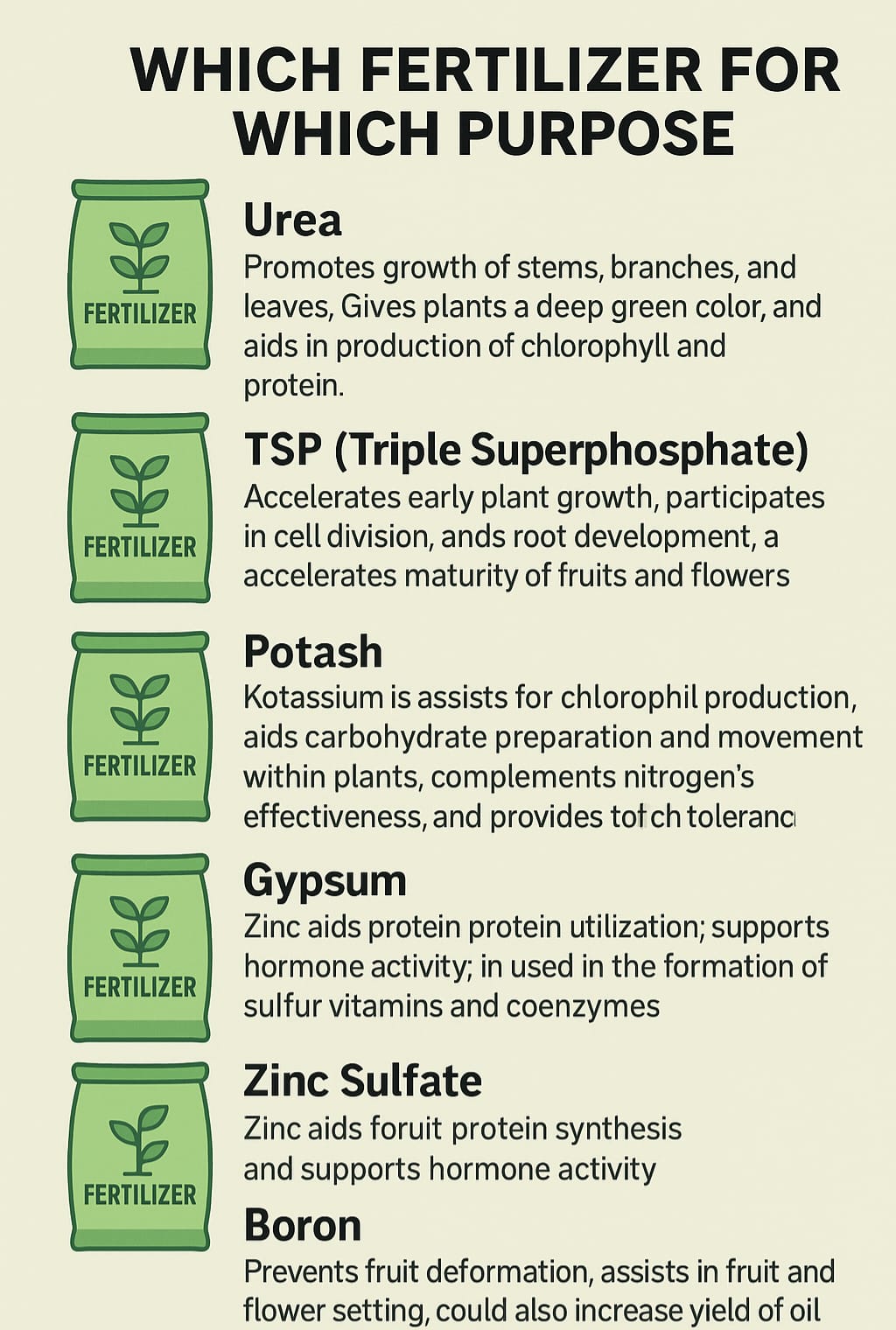
Here’s a complete overview of Fertilizers in agriculture: 1. What is a Fertilizer? A fertilizer is any natural or synthetic substance applied to soil or plants to supply one or more nutrients essential for plant growth. They are used to increase crop yield, improve quality, and replenish soil nutrients lost through cropping. 2. Functions of Fertilizers Provide essential nutrients for plant growth Improve soil fertility Enhance root development, flowering, and fruiting Increase crop yield and quality Correct nutrient deficiencies in soil 3. Classification of Fertilizers A. Based on Nutrient Content Primary Nutrient Fertilizers → Supply N, P, K Nitrogenous fertilizers: Urea, Ammonium Sulphate, CAN Phosphatic fertilizers: TSP (Triple Superphosphate), DAP (Diammonium Phosphate), SSP (Single Superphosphate) Potassic fertilizers: MOP (Muriate of Potash), SOP (Sulphate of Potash) Secondary Nutrient Fertilizers → Supply Ca, Mg, S Example: Gypsum (CaSO₄·2H₂O), Dolomite, Epsom salt (MgSO₄·7H₂O) Micronutrient Fertilizers → Supply trace elements (Fe, Mn, Zn, Cu, B, Mo, Cl) Example: Zinc Sulphate, Borax, Ferrous Sulphate B. Based on Origin Organic Fertilizers → From plant/animal residues Farmyard manure (FYM) Compost Green manure Biofertilizers (Rhizobium, Azotobacter, Azospirillum) Inorganic (Chemical) Fertilizers → Manufactured or processed minerals and chemicals Straight fertilizers (supply one nutrient) Complex fertilizers (supply two or more nutrients, e.g., DAP, NPK) 4. Advantages of Fertilizers High nutrient concentration → fast plant response Easy to transport and apply Can be tailored to crop nutrient requirements Increases yield and income 5. Disadvantages of Excessive Use Soil degradation and nutrient imbalance Water pollution due to runoff/leaching (nitrates, phosphates) Greenhouse gas emissions (nitrous oxide from nitrogen fertilizers) Harm to beneficial soil organisms 6. Best Practices for Fertilizer Use (4R Principle) Right source → Choose correct fertilizer type for the crop Right rate → Apply according to soil test recommendations Right time → Apply when crop demand is highest Right place → Place near roots for efficient uptake ✅ Summary: Fertilizers are vital for modern agriculture, supplying essential nutrients to plants for healthy growth and high yields. Sustainable use, guided by soil testing and balanced nutrient management, ensures long-term productivity without harming the environment