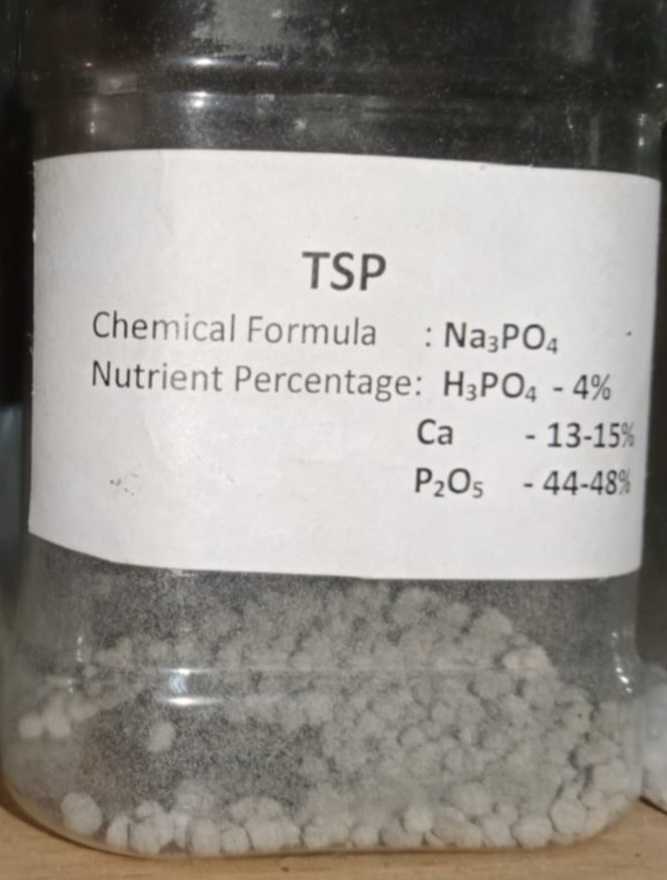
Here’s a detailed explanation of TSP (Triple Superphosphate) in agriculture: 1. What is TSP? Full name: Triple Superphosphate Chemical formula: Ca(H₂PO₄)₂ · H₂O Main nutrient: Phosphorus (P₂O₅) content ~46% (water-soluble form) Appearance: Grayish or brownish granular material Origin: Made by reacting rock phosphate with phosphoric acid 2. Importance in Agriculture Primary role: Supplies phosphorus (P) to plants Function of phosphorus in plants: Promotes root development Enhances flowering & fruiting Aids in energy transfer (ATP synthesis) Improves seed formation & maturation Particularly important in early crop growth stages for strong root systems 3. Advantages of TSP High phosphorus concentration (less bulk to apply) Water-soluble → phosphorus is immediately available to plants Suitable for a wide range of crops — cereals, pulses, oilseeds, vegetables, fruits Excellent for starter fertilizer application 4. Application Methods Basal application: Apply at planting or just before sowing to ensure phosphorus availability during early root development Place in bands or furrows near seeds (but avoid direct seed contact to prevent germination damage) Localized placement: Concentrates phosphorus where roots will grow, improving uptake efficiency Mixing with other fertilizers: Often combined with nitrogen or potassium fertilizers for balanced nutrition 5. Precautions Phosphorus is immobile in soil → must be placed close to roots for effective uptake Overuse can cause soil phosphorus buildup, leading to runoff and water pollution (eutrophication) Avoid surface application without incorporation in heavy rainfall areas, as it may cause losses 6. Environmental Notes Excess phosphorus runoff contributes to algal blooms in water bodies Use soil testing to determine exact phosphorus requirement before applying ✅ Summary: TSP is a concentrated, highly soluble phosphorus fertilizer that boosts root growth, flowering, and yield — especially when applied as a starter fertilizer near seeds or seedlings. Its correct placement and balanced use are crucial for both crop performance and environmental safety.